Clarity in Speech: The Way You Speak Can Make or Break a Workshop
Editor’s Note: This piece sits in Cultivated’s Supporting Library — this one is practical guidance drawn from Workshop Mastery. While much of Cultivated explores systems, meaning, and organisational design, some work remains deliberately hands-on. This is one of those pieces.
The Way You Speak Can Make or Break a Workshop
The way you speak shapes whether people understand, engage, and remember what you teach.
In workshops, business sessions, and conferences, clarity is everything.
Word choice, tone, pace, and expression determine whether ideas land or dissolve into background noise.
Teaching is communication. Facts, enthusiasm, and meaning travel through your voice. If your communication is unclear, your teaching will be too.
Communication extends beyond words.
Posture, facial expression, tone, appearance and presence all signal meaning. Even silence communicates something.
Words Matter
Words carry ideas from your mind into other people’s minds — and they do not land equally for everyone.
Use simple language. Define jargon. Use one term for one idea. Structure sentences clearly.
Then practise. Speak aloud. Record yourself. Listen back. Notice unclear phrasing, filler words, and awkward delivery. Improve one thing at a time.
The Elements of Speech
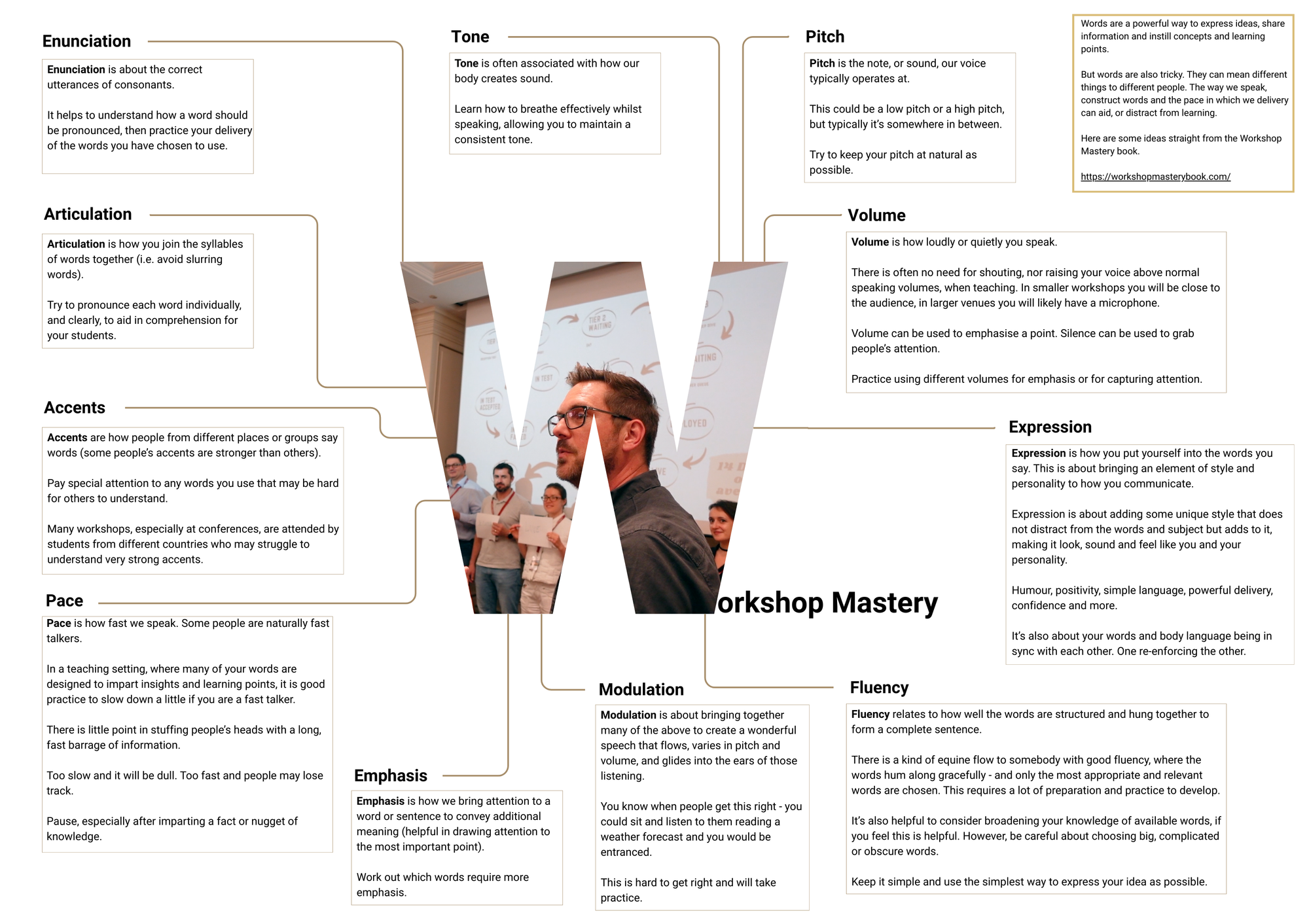
Enunciation Clear pronunciation of consonants. Learn how words are spoken and practise them.
Articulation How syllables connect. Avoid slurring words together.
Accent Accents vary. In international settings, be mindful of words that may be hard to understand.
Emphasis Highlight key words and phrases to signal importance.
Tone Shaped by breathing and vocal control. Aim for steady, relaxed delivery.
Pitch Your natural vocal range. Keep it natural, not strained.
Volume Use normal speaking volume, increasing or lowering for emphasis. Silence can be powerful.
Pace Slow down for clarity. Pause after key points. Avoid flooding people with information.
Fluency Smooth, logical flow of words. Requires preparation and rehearsal.
Modulation Variation in pitch, volume, and rhythm to maintain attention.
Expression Personality, humour, warmth, and confidence — aligned with your body language.
Find Your Style
No two teachers sound the same. That is a strength.
Learn the fundamentals, then experiment. Presence, clarity, and personality make learning engaging. People learn more when they feel energy, intention, and care.
If you’re curious about the craft of teaching — structure, methods, and how to design learning that actually changes behaviour — Workshop Mastery explores these ideas in depth.
The different elements of speech to pay attention to
Explore the work
This piece forms part of Cultivated’s wider body of work on how ideas become valuable, and how better work is built.
To explore further:
→ Library — a curated collection of long-form essays → Ideas — developing thoughts and shorter writing → Learn — practical guides and tools from across the work → Work with us — thoughtful partnership for teams and organisations
The link has been copied!
Your link has expired. Please request a new one.
Your link has expired. Please request a new one.
Your link has expired. Please request a new one.
Great! You've successfully signed up.
Great! You've successfully signed up.
Welcome back! You've successfully signed in.
Success! You now have access to additional content.