Editor’s note: This essay sits within the Cultivated library on vision, alignment, and systems. The Painted Picture is explored as the first act of Releasing Agility — creating the narrative and conditions for meaningful change before ideas become value.
The Power of a Painted Picture
The first step in releasing business agility is deceptively simple: paint a picture of the future.
Not a strategy deck. Not a roadmap. A story of the future that people can see, feel, and want to bring into being.
A painted picture is not the plan. It is the narrative gravity and emotional connection that makes planning possible.
Releasing Agility Comes Before Idea → Value
Most organisations jump straight to execution frameworks. They optimise delivery, improve flow, and accelerate output — often without clarity on why or where they are going.
It is the sensemaking layer. The lens that creates the case and conditions for change.
Only once people understand the future and the gap towards it does Idea → Value matter.
In the Idea → Value course we cover how the painted picture sits above - and guides decisions, strategy, plans, investment and value.
This essay can also be explored in audio form. You’re welcome to listen — or continue reading below.
The Releasing Agility Model
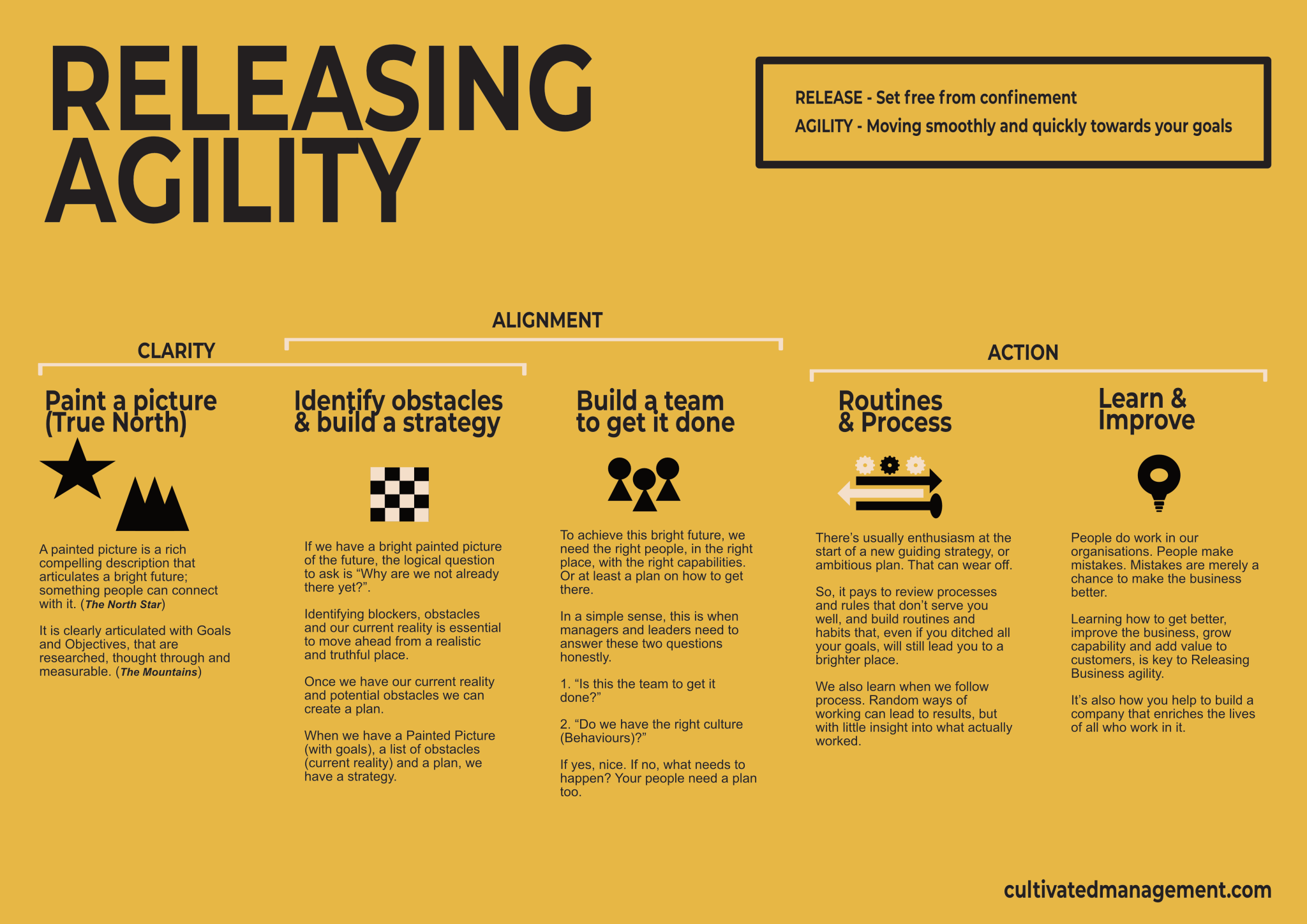
Releasing Agility is a five-step system for organisational movement:
1. Paint a Picture of the Future A compelling narrative future — the world you want to create. The business you want to be part of.
2. Ask Why We Are Not Already There Surface current reality, constraints, and systemic problems.
3. Right People, Right Place, Right Behaviours Assess whether the current team, structure, and culture can reach the future.
4. Routines, Habits, and Processes Design the operating system that turns intention into action.
5. Learning (Running Underneath Everything) Continuous learning loops that adapt direction and execution.
Painted Picture is not a vision statement. It is the first act of organisational sensemaking.
The Cultivated Management Releasing Business Agility model
What a Painted Picture Really Is
A painted picture is an emotional True North.
It describes:
Purpose — why you exist
Culture — how it feels to work here
Impact — who you help and how their lives change
It is written as if it already exists. It is narrative, not numeric.
Without it, organisations optimise for local wins, chase interesting problems, and move smoothly in the wrong direction.
Principles for a Painted Picture
Write 2–5 years ahead. Far enough for transformation or growth, close enough to feel real.
Suspend constraints. Reality comes later. First, define “better.” Define what you want.
Use the present tense. “We deliver weekly with zero downtime” beats “We will…”
Make it emotionally compelling. If people are not moved, nothing moves.
Forget the how. Process comes in Step 4. This is about meaning.
Crafting the Picture
Start with purpose. Define who you serve and why. Describe success in human terms. Describe a bright, compelling and exciting future.
Then edit. Leave space between drafts. Read it aloud. Ask: Would I want to work toward this? Is it exciting? Does it sound challenging? Is it emotionally compelling?
Invite input — but curate it. Too many voices dilute narrative coherence.
Painted Pictures in Practice
When Patagonia says, “We’re in business to save our home planet,” they’re painting a picture — not of jackets or profit, but of purpose.
That simple statement guides every decision, product, and hire.
Compare that to a business that says, “We aim to be number one in our sector.” There’s no emotion, no story, no reason to care. One mobilises hearts; the other just moves spreadsheets.
Tesla did this brilliantly in its early years. The story wasn’t “we make electric cars,” it was “we accelerate the world’s transition to sustainable energy.” That’s a painted picture — bold, emotional, and directional. (Please note, I am not advocating for Elon Musk, far from it – but he did paint a bright picture that galvanises people.)
Why Painted Pictures Work
A compelling picture:
Creates purpose beyond tasks
Aligns priorities
Generates emotional investment
Guides decisions under uncertainty
Without it, organisations optimise PowerPoint strategies, goals and incremental improvements — often manufacturing future problems.
When it does work:
Everyone can articulate the story of where the organisation is heading.
Decisions about projects or investments are guided by that story.
Communication about the future happens often, through stories and visuals.
People feel emotionally connected — they understand why their work matters.
New hires are inspired by the picture
Communicating the Picture
A picture unseen is useless.
Share it:
In all-hands forums
Through leadership narratives
In 1:1s and team rituals
In internal channels
In ongoing storytelling
In different mediums and formats
The picture is not a launch artefact. It is a recurring narrative instrument. It is the emotional connection to the business.
Mountains Before the Horizon
Goals are mountains on the path to the picture.
Set goals that directly move toward the narrative horizon. Expect new goals to emerge once reality is understood (Step 2).
Goals guide movement. The picture gives meaning to movement.
Ambition and Resistance
Every meaningful picture attracts scepticism.
“It’s unrealistic.” “That’s not how we do things.” "It sounds too hard"
Good. Transformation requires narrative tension.
If your first picture is easy to reach, rewrite it bigger.
A painted picture should stretch identity, behaviour, and systems.
The Acid Test
Is the picture changing behaviour?
More collaboration
Better decisions
Higher energy
Clearer priorities
If not, it is not compelling enough — or systemic constraints remain unresolved.
Painted Picture as the First Act of Change
A painted picture is not a slogan. It is the narrative architecture of change.
Releasing Agility begins with meaning. Idea → Value begins with execution.
Without a painted picture, agility is directionless. With it, organisations move smoothly and quickly toward outcomes that matter.
Explore the work
This piece forms part of Cultivated’s wider body of work on how ideas become valuable, and how better work is built.
To explore further:
→ Library — a curated collection of long-form essays → Ideas — developing thoughts and shorter writing → Learn — practical guides and tools from across the work → Work with us — thoughtful partnership for teams and organisations
The link has been copied!
Your link has expired. Please request a new one.
Your link has expired. Please request a new one.
Your link has expired. Please request a new one.
Great! You've successfully signed up.
Great! You've successfully signed up.
Welcome back! You've successfully signed in.
Success! You now have access to additional content.