On Music, Work, and the Shape of Attention
An essay on music, silence, and how rhythm shapes attention, mood, and the experience of modern work.

An essay on music, silence, and how rhythm shapes attention, mood, and the experience of modern work.
Editorial Note: This essay sits within Cultivated’s canon exploring attention, energy, and the human experience of work. It is less concerned with optimisation, and more with how rhythm, silence, and sound shape our ability to think, feel, and stay well inside modern working life.
Listening to music while I work has been a lifelong habit.
Not during meetings.
Not on video calls.
But always during deep, solitary work.
I assumed it helped.
It felt like it did.
It lifted my mood.
It softened stress.
It made long stretches of thinking feel possible.
But I kept wondering whether that was just preference — or whether something deeper was happening.
So I started paying attention.
And reading.
And testing it on myself.
There is a lot of research on music and work. (See Bibliography towards the end)
Some of it points to improved mood, reduced anxiety, and even pain relief.
Some of it shows no meaningful effect on performance at all.
Some of it suggests that music helps — until it doesn’t.
The truth is untidy.
And that’s important.
Because work is untidy too.
A lot of modern work is cognitively demanding and emotionally loaded.
Deadlines.
Ambiguity.
Constant switching.
Pressure without pause.
Against that backdrop, music often acts less like a productivity tool and more like a regulator.
A way to steady the nervous system.
A way to create a container for attention.
A way to soften the edges of a demanding day.
That alone matters.
I’ve lived through periods of intense stress at work.
Heavy responsibility.
High stakes.
Little margin.
During those times, music wasn’t something I used to perform better.
It was something I leaned on to stay well.
There is good evidence that music can reduce anxiety, improve mood, and help people cope with pain. (See Bibliography)
That doesn’t make it a performance hack.
It makes it human.
Where things get more complicated is focus.
Some studies suggest music can improve productivity, especially in simpler or more repetitive tasks. (See Bibliography)
Others show no improvement at all.
Some even show reduced performance — particularly for introverts, or when tasks require deep comprehension.
Silence, it turns out, has a role too.
Especially when learning.
Especially when reading.
Especially when trying to understand something new.
That surprised me less once I noticed my own patterns.
I rarely listen to music when I’m studying.
I sit in silence.
I read slowly.
I let the material work on me.
But when I’m writing, sketching, or connecting ideas — music opens a door.
Not lyrical music.
Not demanding music.
But rhythm.
Texture.
Flow.
There was a moment, years ago, when this became very clear to me.
The night before a keynote.
In a foreign city.
Knowing something wasn’t right.
Panic rising.
Thinking narrowing.
Music didn’t solve the problem.
But it changed my state.
Enough to see clearly.
Enough to cut what didn’t belong.
Enough to sleep.
The talk went on to become one of the most important I’ve given.
Not because of the music.
But because it helped me arrive.
Over time, I’ve learned that music is less about output and more about access.
Access to calm.
Access to energy.
Access to memory.
Access to creativity.
Different sounds open different rooms.
Silence opens one.
Jazz opens another.
Hip hop, another.
Classical music, yet another.
None of them are universal.
That’s the point.
When it comes to work, the most humane position seems to be this:
Let people choose.
Music through headphones, if they want it.
Silence, if they need it.
No broadcast soundtracks.
No forced focus.
Attention is personal.
Rhythm is personal.
What steadies one person distracts another.
Music, for me, is not a tool.
It’s a companion.
A way of shaping the internal environment in which thinking happens.
And in a world where work is increasingly abstract, pressured, and cognitively heavy, that feels like something worth protecting.
Not to make us faster.
But to help us stay human.
Editor’s note: This essay grows from an earlier exploration in another medium. The thinking remains central, even as the format has changed.
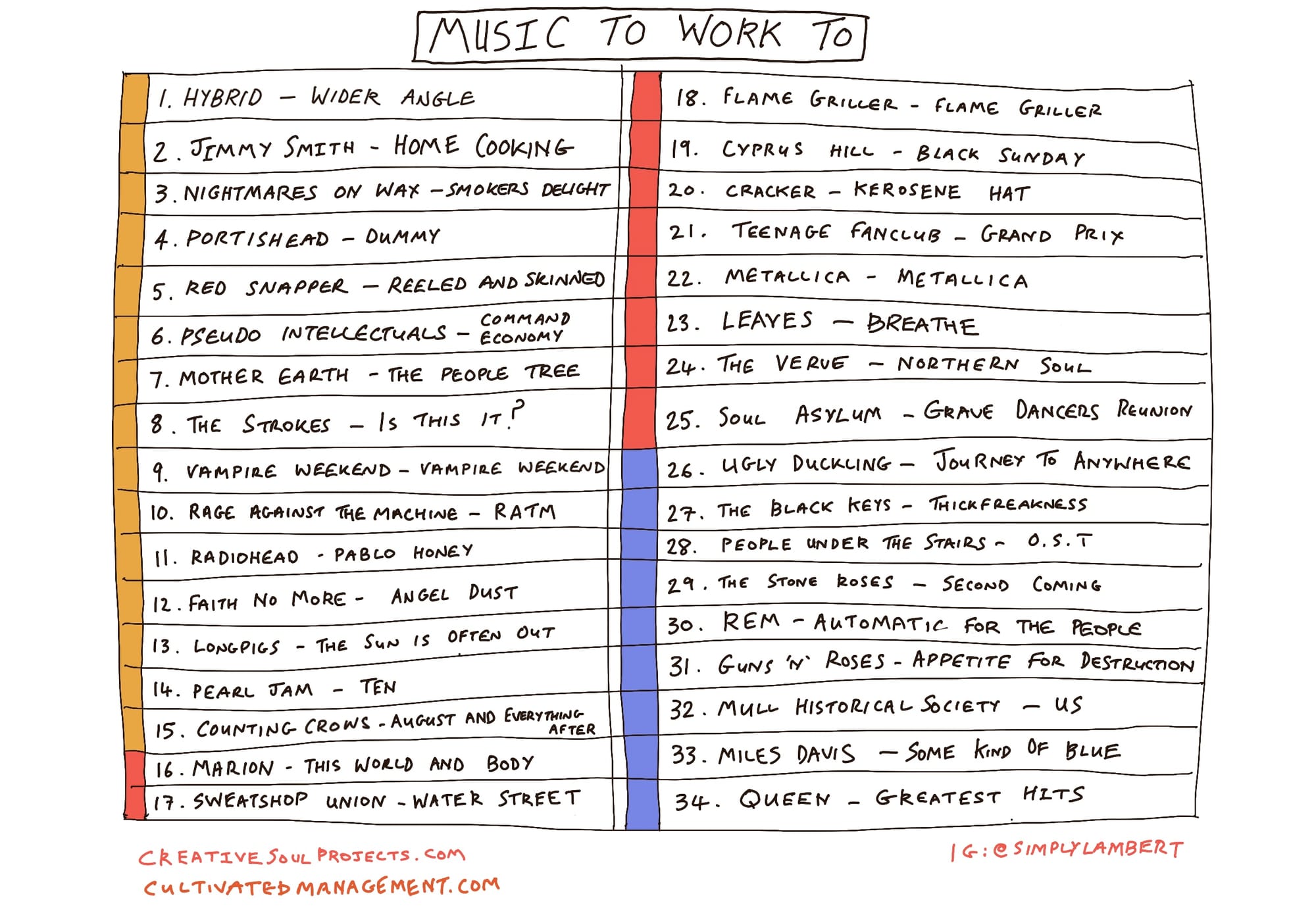
This piece forms part of Cultivated’s wider body of work on how ideas become valuable, and how better work is built.
To explore further:
→ Library — a curated collection of long-form essays
→ Ideas — developing thoughts and shorter writing
→ Learn — practical guides and tools from across the work
→ Work with us — thoughtful partnership for teams and organisations
If you need some help with low mood, depression and anxiety here are some resources:
👉 Mind.Org have a big list of helpful resources, support lines and advice.
👉 CALM - Campaign Against Living Miserably
👉 NHS iTalk
👉 Shout
[1] S. Tottle, ‘Dropping like flies: the rise of workplace burnout and how to tackle it’, The Conversation. Accessed: July 18, 2024. [Online]. Available: http://theconversation.com/dropping-like-flies-the-rise-of-workplace-burnout-and-how-to-tackle-it-67494
[2] ‘Listen while you work? Quasi-experimental relations between personal-stereo headset use and employee work responses.’. Accessed: July 18, 2024. [Online]. Available: https://psycnet.apa.org/buy/1996-93458-001
[3] J. Hutabarat, S. Soeparman, P. Pratikto, and P. B. Santoso, ‘Influence of Singing Dancing During a Rest Break Towards Productivity and Product Quality’, World Applied Sciences Journal, pp. 1239–1250, 2013, doi: 10/influent%2520singing.pdf.
[4] A. Furnham and A. Bradley, ‘Music while you work: the differential distraction of background music on the cognitive test performance of introverts and extraverts’, Applied Cognitive Psychology, vol. 11, no. 5, pp. 445–455, 1997, doi: 10.1002/(SICI)1099-0720(199710)11:5%3C445::AID-ACP472%3E3.0.CO;2-R.
[5] J. H. , ‘The Effects of Music on Pain: A Meta-Analysis’, Journal of Music Therapy, vol. 53, no. 4, pp. 430–477, Dec. 2016, doi: 10.1093/jmt/thw012.
[6] D. Fancourt, A. Ockelford, and A. Belai, ‘The psychoneuroimmunological effects of music: A systematic review and a new model’, Brain, Behavior, and Immunity, vol. 36, pp. 15–26, Feb. 2014, doi: 10.1016/j.bbi.2013.10.014.
[7] H.-J. Trappe, ‘The effects of music on the cardiovascular system and cardiovascular health’, Heart, vol. 96, no. 23, pp. 1868–1871, Dec. 2010, doi: 10.1136/hrt.2010.209858.
[8] G. Schlaug, A. Norton, K. Overy, and E. Winner, ‘Effects of Music Training on the Child’s Brain and Cognitive Development’, Annals of the New York Academy of Sciences, vol. 1060, no. 1, pp. 219–230, 2005, doi: 10.1196/annals.1360.015.
[9] S. Vanderark, I. Newman, and S. Bell, ‘The Effects of Music Participation on Quality of Life of the Elderly’, Music Therapy, vol. 3, no. 1, pp. 71–81, Jan. 1983, doi: 10.1093/mt/3.1.71.
[10] P. Purnell-Webb and C. P. Speelman, ‘Effects of Music on Memory for Text’, Percept Mot Skills, vol. 106, no. 3, pp. 927–957, June 2008, doi: 10.2466/pms.106.3.927-957.
[11] W.-C. Hsu and H.-L. Lai, ‘Effects of music on major depression in psychiatric inpatients’, Archives of Psychiatric Nursing, vol. 18, no. 5, pp. 193–199, Oct. 2004, doi: 10.1016/j.apnu.2004.07.007.
[12] S. E. Schwartz, B. Fernhall, and S. A. Plowman, ‘Effects of Music on Exercise Performance’, Journal of Cardiopulmonary Rehabilitation and Prevention, vol. 10, no. 9, p. 312, Sept. 1990.
[13] R. I. Newman Jr., D. L. Hunt, and F. Rhodes, ‘Effects of music on employee attitude and productivity in a skateboard factory’, Journal of Applied Psychology, vol. 50, no. 6, pp. 493–496, 1966, doi: 10.1037/h0024046.
[14] N. Kahar et al., ‘Perceptions of Music and its Effect on the Productivity of Students’, ASEAN Journal of Educational Research and Technology, vol. 3, no. 1, Art. no. 1, 2024.
[15] Schoenwald, Kyle ‘Music in the Workplace Environment and Productivity - ProQuest’. Accessed: July 18, 2024. [Online]. Available: https://www.proquest.com/openview/015f705e41066bc680df9aa0489e7010/1?pq-origsite=gscholar&cbl=18750&diss=y
