The Problem with Management by Committee
Consensus feels collaborative, but it often slows decisions and erodes momentum. Here’s how leaders can balance consultation with clear ownership and decisive action.


The Problem with Management by Committee
There is a quiet pattern I see across organisations that appears healthy, collaborative, and inclusive
— yet often slows progress to a crawl.
I call it management by committee.
And in practice, it can become a subtle form of organisational self-sabotage.
Most people think committees are formal governance groups that approve decisions. What I see more often is managers outsourcing decisions to their teams in the name of inclusion.
Consulting people is good management.
Abdicating responsibility is not.
Editor's note — where this sits
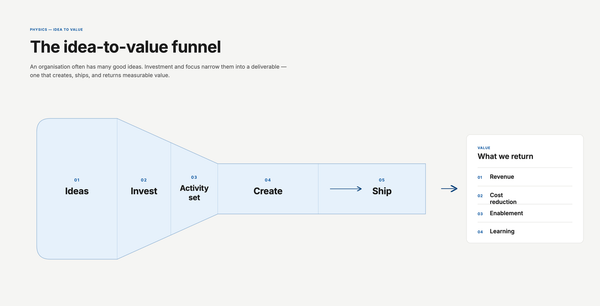
This essay sits in the Map layer of the Idea to Value system — the layer concerned with direction, orientation, and clarity of responsibility. It examines what happens when decision-making becomes diffuse — and why restoring clear ownership is often the first step toward restoring movement.
The Idea to Value system — five layers
When Consensus Becomes Paralysis
I’ve seen three patterns repeat.
One manager refused to act without unanimous agreement.
Decisions became rare.
When they happened, they were diluted compromises that solved nothing and created tomorrow’s problems.
Another manager spoke to everyone individually before acting.
Weeks passed in conversations.
Momentum evaporated.
Frustration grew.
The role eventually changed hands due to lack of progress.
A leadership team tried to standardise on a cloud platform.
They agreed in the room.
Outside the room, everyone continued with their own preference.
No decision held.
Costs and complexity multiplied.
The leader avoided pulling rank — and the organisation paid for it.
Seeking 100% agreement sounds noble.
In practice, it often erodes momentum, clarity, and accountability.
Disagree and Commit
In two decades of leadership, I cannot recall a strategic decision everyone agreed with.
Nor should they.
A healthier pattern and behaviour is disagree and commit.
People share concerns.
Their input is considered seriously.
A decision is made.
Everyone commits
— even if it wasn’t their preferred path.
This preserves insights and disagreement without destroying alignment.
The Manager’s Responsibility
Some decisions simply belong to management — strategic direction, financial choices, addressing underperformance, operational priorities, and fixing services under pressure.
Managers work for the organisation.
Our role is to solve business problems with people, not to crowdsource every decision to everyone.
Not every opinion carries equal weight.
Some people enjoy conflict.
Others lack context, experience, or commercial awareness.
Listening matters — but leadership requires learned judgment.
A Simple Decision-Making Framework
To avoid management by committee while still harnessing collective intelligence, a simple sequence:
Quick reference — decision framework
The mapA simple decision-making sequence
For harnessing collective intelligence without outsourcing the decision itself.
Define the problem clearly
A vague problem produces vague decisions. Be specific about what needs to be resolved.
Consult trusted experts
Not everyone — those with relevant context, experience, or accountability.
Gather evidence and data
Ground the decision in reality, not opinion or political preference.
Create a small set of viable options
Two or three well-formed options. Not an exhaustive list — that invites paralysis.
Share for feedback
Invite input on the options — not on whether a decision should be made.
Integrate valid input
Not all feedback carries equal weight. Integrate what is grounded; note the rest.
Finalise the direction
Narrow to one option. This is the last moment before closure.
Make the decision
Decisions close options. That is their function. Do not soften this step.
Encourage disagree and commit
Dissent is preserved. Alignment is expected. Both matter.
Implement with energy and focus
A decision half-implemented is rarely better than no decision at all.
The manager who never consults the team should worry.
The manager who insists on full consensus will rarely move forward.
The best managers listen deeply, decide clearly, and move deliberately.
Management is not about pleasing everyone. It is about creating clarity, alignment, and momentum in service of outcomes.
Disagree and commit is not a slogan.
It is a behaviour worth cultivating.
From the Cultivated library
10 Behaviours of Effective Employees
Free eBook · Coaching guide · Digital
The behaviours that make disagree-and-commit possible in practice — including how effective people handle decisions they didn't choose and commit to outcomes they didn't design.
Free to start
Get the free eBook →Workshops & Keynotes
In-person or virtual · Bespoke
For leadership teams caught in the committee pattern — where decisions are rare, diluted, or simply not held. A practical session for restoring clarity, ownership, and momentum.
Enquire
Start the conversation →