The Future Belongs to Those Who Can Communicate It
Good leaders do not wait for the future to arrive. They anticipate it, decide which version matters, and communicate it clearly enough for others to help bring it to life.
The Future Belongs to Those Who Can Communicate It
Editorial Note: This essay is part of the Cultivated canon — a body of work exploring leadership as an act of orientation: helping people understand where they are, where they are going, and why it matters.
The Future Belongs to Those Who Can Communicate It
A great deal of my work revolves around helping teams move toward brighter futures.
That work is rarely about speed. It is almost always about direction.
“The future belongs to those who can communicate about it.”
Good leaders do not wait to discover the future. They participate in its creation. They anticipate what may lie ahead, decide which future is worth pursuing, and then do the harder work of bringing others with them.
This is the first principle in my work on business agility: paint a bright picture of the future and align people around it.
It sounds simple. It rarely is.
When work becomes difficult — when pressure rises, energy dips, or progress feels slow — people want to know what they are moving towards. They want to understand the harbour they are aiming for, not just the effort required to keep rowing.
“You must know for which harbour you are headed if you are to catch the right wind.” — Seneca
Without that orientation, no wind is favourable.
The Painted Picture
The painted picture — sometimes called True North — is the emotional dimension of strategy.
It is not a list of metrics. It is not a roadmap. It is a story about what the organisation is trying to bring into being, and why that future is worth the effort.
A well-formed painted picture does several things at once:
It explains what success feels like, not just how it is measured
It frames today’s problems as part of a larger journey
It provides meaning when the work becomes difficult or repetitive
It helps people "see" the future in their mind
At its core, it is an act of storytelling — one grounded in reality, but oriented toward possibility.
There Is More Than One Future
One of the mistakes leaders make is assuming there is a single, inevitable future.
There isn’t.
To explore this properly, I often use Jim Dator’s four archetypes of the future — not as predictions, but as lenses for thinking.
Continuity and Growth The business continues largely as it is, improving incrementally. Even here, leadership is required. Without attention, continuity quietly degrades.
Collapse Without intervention, systems decay. This future often arrives not through dramatic failure, but through prolonged neglect.
Discipline Problems are named and addressed. Good practices are reinforced. This future demands focus, behavioural change, and difficult conversations.
Transformation The organisation becomes something fundamentally different. Not better at the old game, but engaged in a new one entirely. This future requires courage, clarity, and exceptional communication.
None of these futures arrives by accident. Each is shaped — actively or passively — by leadership choices.
Visualising Possibility
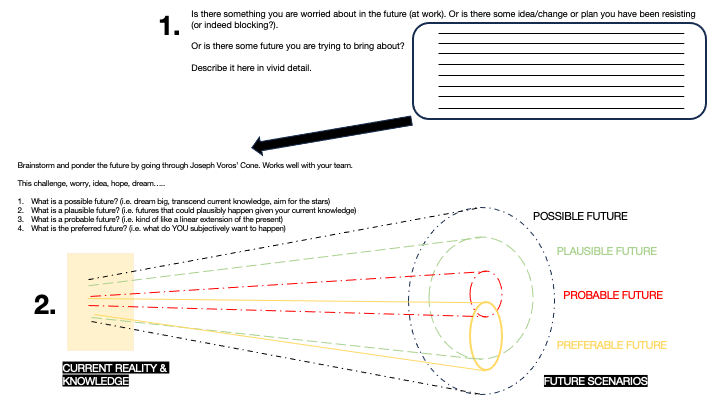
Once these archetypes are understood, the futures cone becomes a useful way of thinking about direction.
It invites teams to consider:
Possible futures — unconstrained by current assumptions
Plausible futures — grounded in what we understand today
Probable futures — likely extensions of present trends
Preferred futures — what people want to happen
Paying attention to preferred futures matters, even when the organisation must choose a different path. Preferences offer insight into motivation, fear, and hope — all of which shape engagement.
Futures thinking works best when it is tangible. Doodles, post-its, sketches, and shared conversation allow people to externalise their thinking and see the future together, rather than alone.
A drawing of the futures cone showing plausible, possible, probable and preferable futures
From Imagination to Movement
Imagining futures is not the hard part.
Mobilising people toward one is.
Whether the chosen future is incremental, disciplined, or transformational, progress depends on three things:
Clear narrative
Consistent communication
Steady execution
This is where leadership shows itself — not in the brilliance of the vision, but in the ability to hold it steady over time.
“The future belongs to those who can communicate about it.”
Business agility is not about reacting faster. It is about moving with intent. About ensuring people understand not just what they are doing, but why it matters.
When leaders take responsibility for anticipating the future — and communicating it with clarity and care — organisations stop drifting.
They begin to move.
Explore the work
This piece forms part of Cultivated’s wider body of work on how ideas become valuable, and how better work is built.
To explore further:
→ Library — a curated collection of long-form essays → Ideas — developing thoughts and shorter writing → Learn — practical guides and tools from across the work → Work with us — thoughtful partnership for teams and organisations
The link has been copied!
Your link has expired. Please request a new one.
Your link has expired. Please request a new one.
Your link has expired. Please request a new one.
Great! You've successfully signed up.
Great! You've successfully signed up.
Welcome back! You've successfully signed in.
Success! You now have access to additional content.