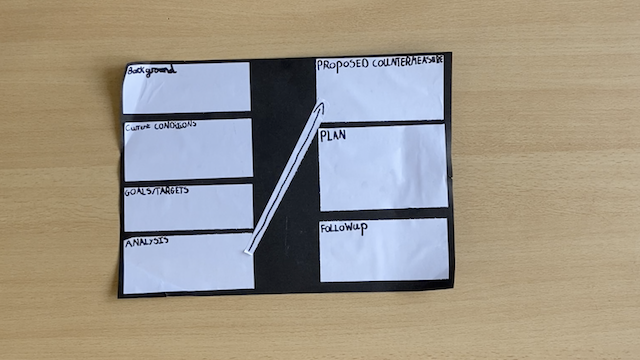
A3 Thinking is not a template or a form to complete. It is a discipline for slowing down, studying problems properly, and moving from opinion to evidence.
Editorial Note This essay is part of the Cultivated canon — a body of work concerned with reducing the distance between idea and value. It focuses on a recurring theme in this library: that most organisational problems persist not because they are complex, but because they are poorly understood.
How To Solve Real Problems with A3 Thinking
When I work with clients to solve difficult problems, I almost always start the same way.
With a single sheet of A3 paper.
A3 Thinking originated at Toyota , but its value has little to do with manufacturing. It is a way of thinking — a discipline that forces clarity, evidence, and intent into situations that are often clouded by opinion, politics, and haste.
The appeal of A3 Thinking is its constraint. An A3 sheet offers just enough space to capture the essence of a problem and decide what to do next — but not enough to hide behind excessive analysis, slides, or process.
It encourages movement, but not recklessness. Progress, but not guesswork.
Many problem-solving efforts fail for a simple reason: people rush to solutions before they truly understand the problem. What emerges is activity, not progress. Opinion replaces evidence. Noise replaces learning.
A3 Thinking pushes against that instinct.
At its heart, the method asks you to slow down long enough to see clearly.
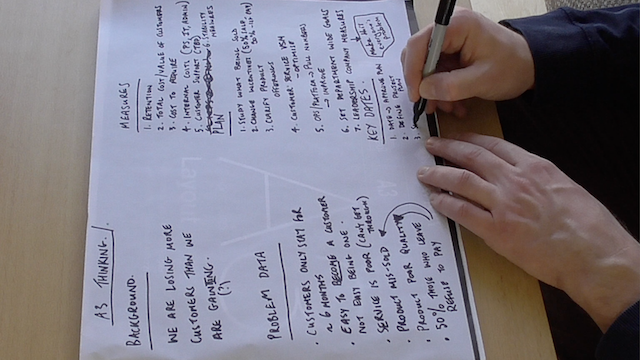
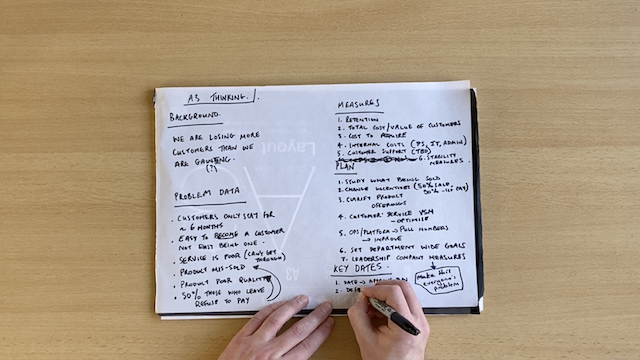
I structure my A3 work around five simple sections. Not as a rigid template, but as a thinking aid.
It begins with an introduction — a clear articulation of the problem space. Not a solution, not a symptom, but the issue worth studying. Getting this wrong leads to wasted effort, so clarity here matters. The problem statement often evolves as understanding deepens, and that is a sign the thinking is working.
Next comes problem data. This is the most important part of the exercise. Real problems require evidence. Numbers, trends, observations, and facts — not just the views of the loudest or most senior voices in the room.
This stage demands care and skill. Gathering data is not about blame. It is about understanding cause and effect. Without evidence, you are not solving a problem — you are debating one.
Measures follow naturally. If the problem matters, it should connect to outcomes that matter. Measures help distinguish between activity and impact. They allow you to see whether change is actually improving the system, or merely shifting work around.
Good measures are rarely perfect. They are often proxies. But they must relate to purpose, and they must show movement over time. Single data points are rarely enough.
Only then does planning begin.
A3 Thinking deliberately limits the scale of plans. There is no room for elaborate programmes or long roadmaps. Instead, the focus is on the next sensible step. Small experiments. Clear ownership. Learning built into action.
The question is not what is the perfect solution? but what can we try next that will teach us something useful?
Finally, key dates bring intent into reality. Without time boundaries, good intentions drift. Dates should encourage action, not panic. They exist to create momentum and reflection, not artificial urgency.
Used well, A3 Thinking becomes a quiet antidote to many organisational habits: rushing, guessing, defending, and performing certainty.
It does not remove politics, ego, or resistance — in fact, it often surfaces them. Many problems persist because they serve someone’s interests. Studying them properly can feel threatening.
But this is where the leverage lies.
Instead of shifting the burden, launching initiatives, or creating busy work from faulty assumptions, A3 Thinking brings attention back to what actually matters. It reconnects effort to evidence, and action to learning.
It is not the only way to solve problems.
But it is one of the most reliable ways I know to turn confusion into clarity — and clarity into value.
And that, in the end, is the work.
Video
Editor’s note: This essay grows from an earlier exploration in another medium. The thinking remains central, even as the format has changed.
A3 Thinking in Action
Explore the work
This piece forms part of Cultivated’s wider body of work on how ideas become valuable, and how better work is built.
To explore further:
→ Library — a curated collection of long-form essays → Ideas — developing thoughts and shorter writing → Learn — practical guides and tools from across the work
The link has been copied!
Your link has expired. Please request a new one.
Your link has expired. Please request a new one.
Your link has expired. Please request a new one.
Great! You've successfully signed up.
Great! You've successfully signed up.
Welcome back! You've successfully signed in.
Success! You now have access to additional content.