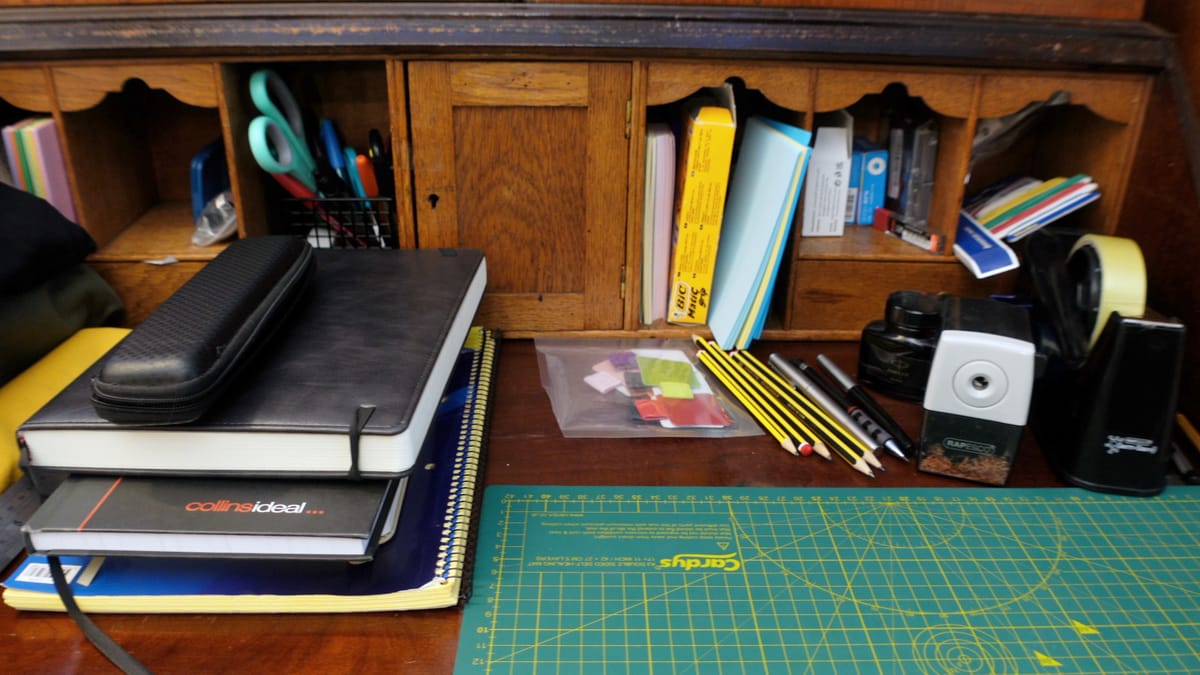
Why Journaling Became My Quiet Advantage at Work and in Life
Journaling became a quiet discipline that changed how I think, lead, and live. This essay explores why reflection, not speed, is the foundation of a good working life.
Why Journaling Became My Quiet Advantage at Work and in Life
Editor’s note: This essay forms part of Cultivated’s human foundations canon — exploring the inner disciplines that quietly shape good work and good leadership.
Why Journaling Became My Quiet Advantage at Work and in Life
Journaling has been a lifeline for me.
Not in a dramatic way. In a quiet, steady one.
It has helped me work out who I want to become, process difficult periods, and deal with emotions I once carried around for days at a time. Over the years, it has become one of the most practical tools I have for thinking clearly and living deliberately.
For a long time, I failed at it.
I would start enthusiastically, keep it up for a few weeks, then drift away for months. It was only in the past couple of years that the habit finally stuck — and when it did, something shifted.
Because at the heart of Cultivated sits a simple belief:
Our work will never be more developed than we are as people.
If we want to think better, lead better, and work more calmly, we must start by understanding ourselves.
Journaling became one of the ways I learned to do that.
A place to think, not just record
My journal is not a diary of events.
It is a place to think on paper.
Some days I write about what happened. Other days about how I feel. Often about who I am trying to become.
There is no format. No template. No performance.
Just a date at the top of the page — and honesty underneath it.
Over time, the pages become a private conversation with myself. And that conversation changes how I show up everywhere else.
Why writing works
There is good science behind what many of us feel intuitively.
Writing slows the mind just enough for clarity to emerge. It reduces mental noise. It creates distance between emotion and reaction. It frees cognitive space.
But even without the studies, the lived effect is simple:
When thoughts are trapped in the head, they grow louder. When they reach the page, they become manageable.
The act of writing turns confusion and mental chatter into shape.
Why pen and paper matter
I tried journaling digitally. It never worked for me.
When I returned to a simple notebook and pen, something changed immediately.
There is no blue light. No notifications. No quiet pull of unfinished work. No Internet.
Just attention.
Writing by hand creates a different quality of presence. It feels slower — but that slowness is the point.
Clarity is rarely fast.
Serendipity in the margins
There is a subtle gift in paper journals.
Flicking back through old pages reveals patterns you could not see at the time. You notice how worries faded, how perspectives evolved, how resilience quietly grew.
A journal becomes a map of inner terrain.
Not perfect. But honest.
Journaling and leadership
This is a work library after all.
So I keep two journals.
One for life. One for work.
In my work journal I reflect on questions like:
Was I the leader I wanted to be today? Did I hold my standards of behaviour? Where did I fall short? How can I be better tomorrow?
Good leaders are demanding of themselves and generous with others.
A journal helps me stay true to that balance.
A quiet discipline
Journaling has not made me faster. It has made me clearer.
And clarity changes everything downstream — decisions, relationships, leadership, life.
It is not a productivity hack.
It is a practice of attention.
And over time, that attention becomes a quiet advantage.
Not just at work.
But in becoming the person your work is built upon.
Video
Editor’s note: This essay grows from an earlier exploration in another medium. The thinking remains central, even as the format has changed.
Explore the work
This piece forms part of Cultivated’s wider body of work on how ideas become valuable, and how better work is built.
To explore further:
→ Library — a curated collection of long-form essays → Ideas — developing thoughts and shorter writing → Learn — practical guides and tools from across the work
Bibliography
[1] Milbury, K., Spelman, A., Wood, C., Matin, S.F., Tannir, N., Jonasch, E., Pisters, L., Wei, Q. and Cohen, L. (2014). Randomized Controlled Trial of Expressive Writing for Patients With Renal Cell Carcinoma. Journal of Clinical Oncology, [online] 32(7), pp.663–670. Available at: https://www.ncbi.nlm.nih.gov/pmc/articles/PMC3927735/ [Accessed 25 Apr. 2019].
[2] Gortner, E.-M., Rude, S.S. and Pennebaker, J.W. (2006). Benefits of Expressive Writing in Lowering Rumination and Depressive Symptoms. Behavior Therapy, 37(3), pp.292–303.
[3] Klein, K. and Boals, A. (2001). Expressive writing can increase working memory capacity. Journal of Experimental Psychology: General, 130(3), pp.520–533.
[4] Smyth, J.M., Johnson, J.A., Auer, B.J., Lehman, E., Talamo, G. and Sciamanna, C.N. (2018). Online Positive Affect Journaling in the Improvement of Mental Distress and Well-Being in General Medical Patients With Elevated Anxiety Symptoms: A Preliminary Randomized Controlled Trial. JMIR Mental Health, [online] 5(4), p.e11290. Available at: https://www.ncbi.nlm.nih.gov/pmc/articles/PMC6305886/ [Accessed 28 Sep. 2020]
[5] Rodriguez, T. (2013). Write to Heal. Scientific American Mind, [online] 24(5), pp.17–17. Available at: https://www.scientificamerican.com/article/writing-can-help-injuries-heal-faster/ [Accessed 28 Sep. 2020].
[6] Scullin, M.K., Krueger, M.L., Ballard, H.K., Pruett, N. and Bliwise, D.L. (2018). The effects of bedtime writing on difficulty falling asleep: A polysomnographic study comparing to-do lists and completed activity lists. Journal of Experimental Psychology: General, [online] 147(1), pp.139–146. Available at: https://pubmed.ncbi.nlm.nih.gov/29058942/ [Accessed 28 Sep. 2020].
[7] Slotter, E.B. and Ward, D.E. (2014). Finding the silver lining. Journal of Social and Personal Relationships, 32(6), pp.737–756.
[8] Baikie, K.A. and Wilhelm, K. (2005). Emotional and physical health benefits of expressive writing. Advances in Psychiatric Treatment, [online] 11(5), pp.338–346. Available at: https://www.cambridge.org/core/journals/advances-in-psychiatric-treatment/article/emotional-and-physical-health-benefits-of-expressive-writing/ED2976A61F5DE56B46F07A1CE9EA9F9F [Accessed 28 Sep. 2020].
[9] Giada Di Stefano, Francesca Gino, Gary Pisano, and Bradley Staats https://www.sc.edu/uscconnect/doc/Learning%20by%20Thinking,%20How%20Reflection%20Aids%20Performance.pdf
The link has been copied!
Your link has expired. Please request a new one.
Your link has expired. Please request a new one.
Your link has expired. Please request a new one.
Great! You've successfully signed up.
Great! You've successfully signed up.
Welcome back! You've successfully signed in.
Success! You now have access to additional content.