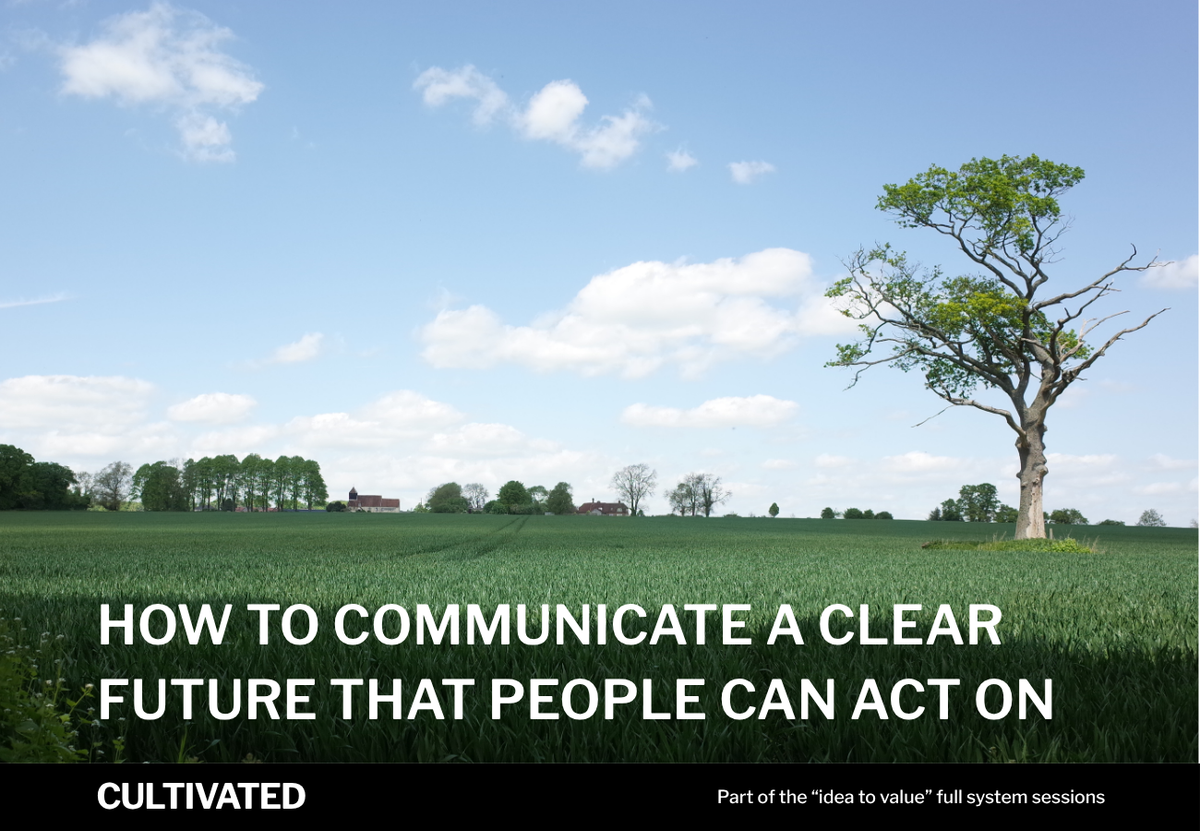
How to Communicate a Clear Future That People Can Act On
Most organisations don’t lack strategy — they lack a future people can see. This piece explores why direction must be communicated clearly, emotionally, and often enough that people choose to move towards it.
Editor’s Note
These sessions explore the Idea → Value system in practice — slower, deeper, and closer to real work. If the essays sketch the outline, these sessions walk the terrain.
Why Clear Communication Creates Alignment, Direction, and Momentum
Most organisations spend their days inside the mechanics of work.
Delivery.
Metrics.
Meetings.
Deadlines.
Targets.
Decisions.
Movement everywhere.
But every so often….
it’s worth stepping back.
To lift above the noise.
Above the activity.
And ask a simpler — and far more difficult — question:
Why are we doing this at all?
Because work without direction becomes repetition.
And repetition, over time, becomes fatigue.
But work with direction?
That’s different.
That becomes momentum.
This is where most organisations quietly struggle.
Not because they lack intelligence.
Not because they lack effort.
But because the future they are working towards…
is unclear.
Or worse —
it exists, but only in fragments.
A slide deck here.
A strategy document there.
A few numbers.
A few phrases.
Not something people can feel.
Not something people can see themselves inside.
And if people can’t see it…
they can’t move towards it.
This is where the idea of a painted picture comes in.
Not a forecast.
Not a spreadsheet.
Not a list of initiatives.
Not as targets, or yet another strategy deck.
A story.
A vivid, emotionally grounded description of the future.
Who we are becoming.
What it feels like to work here.
What kind of organisation we are choosing to build.
What change we are trying to make.
Not fantasy.
Not prediction.
Intention.
Because when that picture exists — clearly and consistently —
something shifts.
Decisions gain clarity.
Investment gains purpose.
People gain motion.
Work stops being a list of tasks…
and starts becoming part of something.
Without it?
Teams drift.
Still competent.
Still busy.
Still delivering.
But disconnected.
And over time, that disconnection shows up as:
- slower decisions
- diluted effort
- quiet disengagement
- work that moves… but doesn’t compound
So the role of leadership is not just to decide what to do.
It’s to make the future visible.
And that takes communication.
Not once.
Not in a town hall.
Not buried in a document.
But clearly enough…
often enough…
and humanly enough…
that people begin to recognise it.
And when people recognise it —
they start to align with it.
Alongside that longer-term picture, we still need nearer horizons.
Goals.
Milestones.
Waypoints.
But these only make sense…
when they sit inside something bigger.
Otherwise, they become isolated targets.
And isolated targets don’t create momentum.
They create pressure.
This isn’t about forcing the future.
Or pretending we know exactly how it unfolds.
It’s about choosing a direction.
Describing it.
And walking towards it — deliberately.
Because the future will arrive anyway.
The only real question is:
Do you arrive there by accident…
or by design?
And the organisations that shape their futures are rarely the loudest.
They’re simply the ones who can describe where they’re heading —
clearly enough…
consistently enough…
and humanly enough…
that others choose to walk with them.
In the full session, we explore how to build this kind of narrative —
why emotion matters more than most people think,
and how a simple story arc can turn direction into movement.
Go Deeper
This article introduces one part of the Idea → Value system course.
If you want to go further — to see how this works in real organisations, and how to apply it in your own work — there are three ways to continue:
- Watch the full studio deeper session — a rich and detailed walkthrough of this idea in practice (available in the Studio) - below.
- Buy the Idea to Value course complete with field guide - and companion video series.
- Start with the Orientation Session — a 20-minute overview of how ideas move from concept to value
All are designed to help you not just understand the system…
but use it.