Breaking Down Silos: Why Interdisciplinary Work Solves Wicked Problems
Most organisational problems live between disciplines, not within them. Interdisciplinary work reveals systemic constraints, generates new knowledge, and enables organisations to solve problems that no single team can tackle alone.
Breaking Down Silos: Why Interdisciplinary Work Solves Wicked Problems
Editor’s Note: This piece sits within Cultivated’s work on systems, complexity, and the limits of functional thinking. It explores why modern organisations struggle with systemic problems — and why interdisciplinary collaboration is often the missing capability.
Breaking Down Silos: Why Interdisciplinary Work Solves Wicked Problems
What begins as clarity slowly becomes fragmentation.
Before long, people are boxed into job families, departments, and budgets. Language diverges. Ways of working dilute. The map takes over from the territory.
And the most important work no longer fits inside any single box.
Customer value always crosses boundaries. Delivery crosses boundaries. Meaningful problems almost always cross boundaries.
Yet organisations continue to assign problems to functions, as if systemic issues could be solved in disciplinary isolation.
Technology team optimises technology. Product team optimises product. Legal team optimises risk.
Each discipline succeeds on its own terms — while the organisation struggles as a whole.
Many of these challenges are what planners once called wicked problems.
They are interconnected, evolving, and resistant to simple solutions. The more complex an organisation becomes, the more wicked its problems tend to be.
Silos make wicked problems harder to see, let alone solve.
Interdisciplinary work is not a workshop format or a collaboration ritual.
It is a way of thinking.
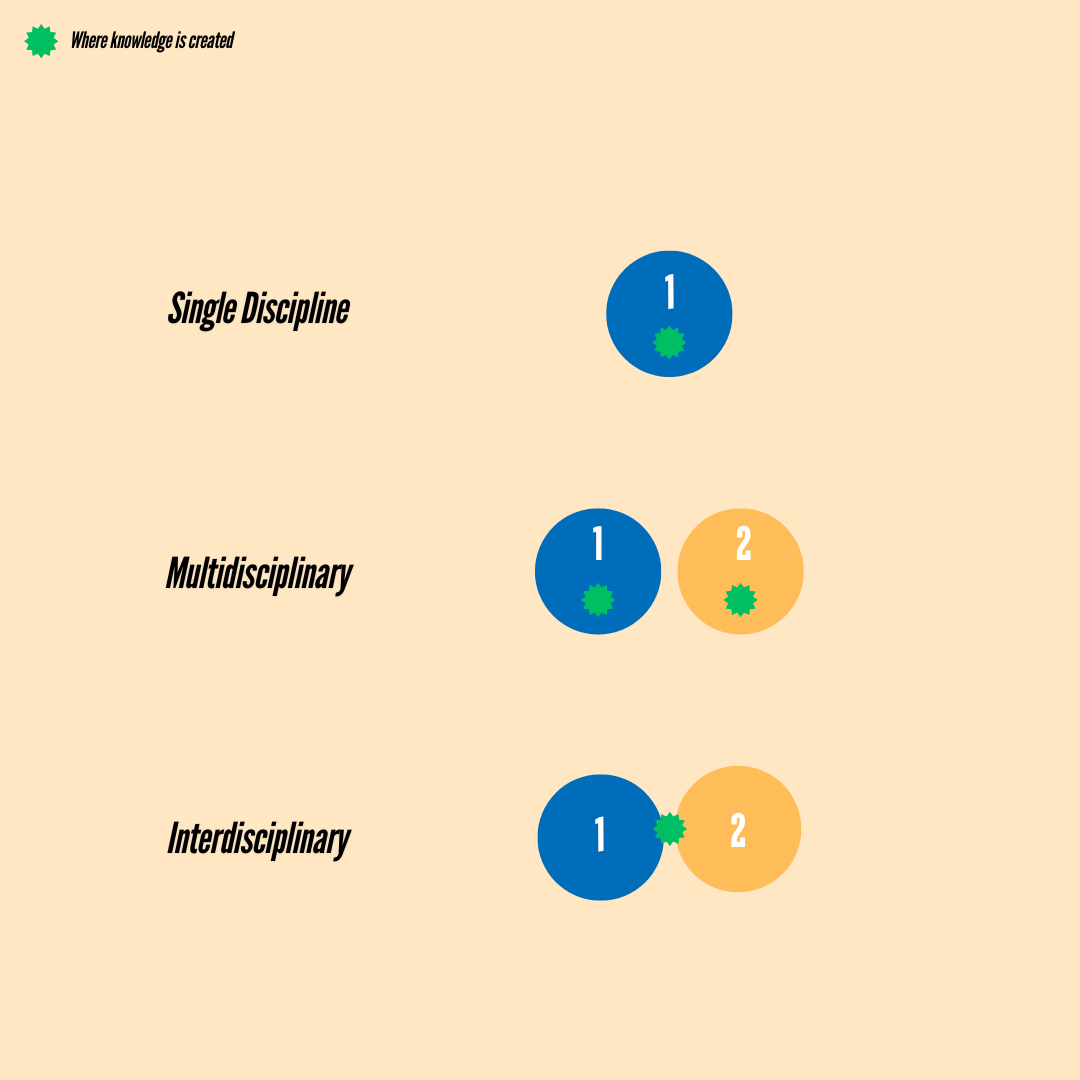
It asks people from different domains to work on the whole problem together — not to contribute fragments from within their silos.
When disciplines meet, something shifts.
Assumptions are challenged. Methods combine. Language changes. New knowledge appears.
The organisation learns — not just about the problem, but about itself.
This is why meaningful improvement rarely comes from a single function.
The most powerful advances happen at the intersections:
Between technology and design. Between operations and finance. Between people and process.
The gaps are where leverage lives.
Silos are comfortable. Functional. Look good on a balance sheet.
Interdisciplinary work is slower, messier, and often political. But it is where understanding deepens and real change begins.
The next time a problem feels immovable, ask where it sits.
If it crosses boundaries — and most meaningful problems do — the solution will need to cross boundaries as well.
The future of effective organisations is not more specialised departments.
It is people willing to think and work beyond them.
The different types of disciplinary approaches
Explore the work
This piece forms part of Cultivated’s wider body of work on how ideas become valuable, and how better work is built.
To explore further:
→ Library — a curated collection of long-form essays → Ideas — developing thoughts and shorter writing → Learn — practical guides and tools from across the work → Work with us — thoughtful partnership for teams and organisations