Be surprised less often
Seasoned people aren't cleverer — they're better oriented. They see what's forming while others are still reacting. On awareness as a practice, weak signals, and why so much of experience is really just earlier sight.


Experience is earlier sight
"My only advice is to stay aware, listen carefully, and yell for help if you need it." — Judy Blume
If you sit in enough meetings and watch enough people you spot something rather curious. Some people seem to already know what's happening before everyone else.
I saw this a few years ago, in my first month at a new company, I watched a woman a couple of seats down close her laptop about forty seconds into a meeting that hadn't visibly gone anywhere yet. "This one's already decided," she murmured, half to herself. "We're just here for the paperwork." She was right. The real decision had been taken three days earlier, in a corridor, by two people who weren't even in the room. I remember assuming she was plugged into the Matrix or something.
She wasn't. She'd simply been paying attention for longer.
That's the often unexamined truth about the people who rarely seem to be caught off guard. We file them under intuition, or luck, or good contacts, or magical – when in reality its always something far less mysterious, and far more learnable. They aren't cleverer, or smarter, than the rest of us; some of the sharpest people I've known couldn't reliably tell you what day it was. They're just better oriented. They noticed the thing taking shape while it was still only a shape. And with a wider awareness of what's forming around you, you'll be surprised a great deal less often.
When I join a new organisation, I don't begin by changing anything. I begin by studying – not academically, but attentively. I watch how the ideas move through the organisation and how the work of making them valuable comes together.
I pay attention to how the business actually works rather than reading the laminated process maps and values stuck by the lift. I listen for what's really being said and, more usefully, for what's carefully never said. I notice where decisions really happen, which is almost never the meeting where they're formally announced. There's nearly always a gap between the two, and the gap is where the real understanding lives.
It's a habit I've watched in effective people again and again: they're in no hurry to impress, only to understand. The energy an impatient leader pours into early interventions and announcing their presence – the quick reorganisation, the confident first-week verdict – a wiser one spends on building a picture of the ground they're about to cross.
Which means awareness isn't really a personality trait you're handed at birth. It's a practice – a behaviour you can cultivate. I find it helps to picture it as a set of fields. Some things sit close: your role, your work, your immediate team, where the signals are strong and arrive daily if you're looking.
Others sit further out – a shift in strategy, a new centre of power quietly forming, a tension building between two functions who've stopped talking to each other. Those signals are faint, and easy to file under noise. And beyond them lies a wide, unlit territory of things that haven't surfaced yet but one day will.
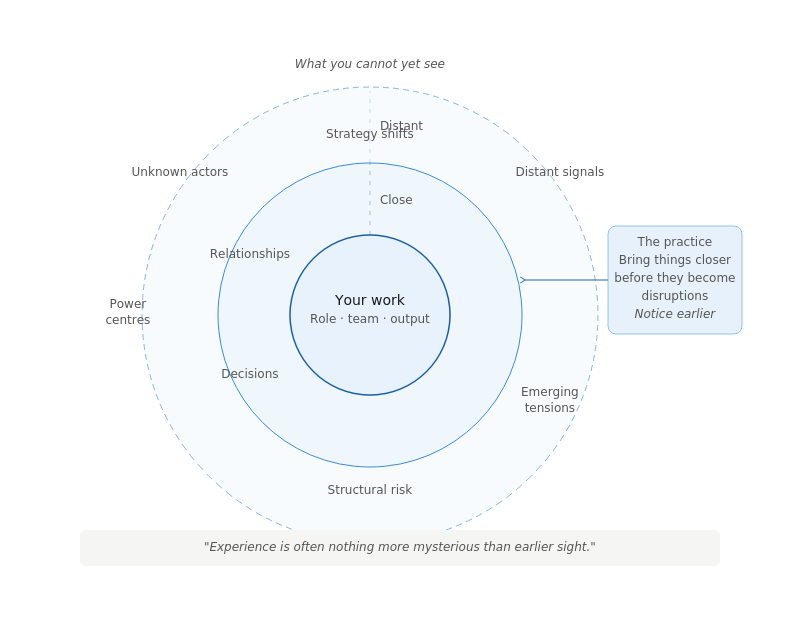
Skilled people don't try to know everything out in that territory – a fool's errand, and an exhausting one. They bring the right things closer, before distance has a chance to turn into disruption. The question they're always asking is a good one to borrow: what don't I yet know that I should?
Take a leader whose support you'll need before long. Perhaps you know them, perhaps only by name, perhaps not at all – in every case the task is the same, which is to reduce the distance. A conversation. A decent coffee. A shared piece of work. As awareness grows, alignment follows, friction falls away, and action gets easier. That's how influence actually forms – not through authority or a job title, but through the accumulated understanding that only comes from real contact.
The people who seem to move through an organisation with disgustingly annoying ease are almost always the ones who did the unglamorous work of building the relationship long before they needed to call on it.
The same goes for surprises, which are hardly ever as sudden as they feel. The strategy shift, the restructure, the risk that lands on a Tuesday – there were almost always early signals, faint but legible to anyone scanning past the immediate. Some people read them; others wait for impact and experience as a shock the very thing that could, in hindsight, have been seen coming a mile off. The difference between the two is rarely intelligence. It's attention. Experience, most of the time, is nothing more mysterious than earlier sight.
It applies to people every bit as much as to processes. A new colleague arrives and you know their title but not their temperament and character. You can wait to discover their influence the hard way – through friction, through a clash of priorities, through learning a fortnight too late that they were exactly the person who should have been in the room. Or you can introduce yourself, build a little context early, and have a working understanding in hand before you urgently need one.
Effective people subtly map the human system around them: who helps things move, who needs support, who shapes outcomes informally without any of the formal power to do so. This isn't political manoeuvring. It's orientation – the same attention a good diagnostician gives a system, turned toward the people inside it.
And then there's the one field we're all worst at scanning: ourselves. Widening awareness turns inward too. Knowing your real strengths rather than the ones you'd like to have. Spotting your blind spots before everyone around you does. Understanding where you need people who see the world differently. Self-awareness lets you shape your surroundings on purpose – to build a team that complements you rather than one that flatters you by agreeing with every hair-brained idea you have. Learning begins where certainty finishes, and the people who've stopped being surprised by the world outside them have a remarkable habit of noticing as much as they can.
None of this is about control. It's about position. When you understand the terrain – the relationships, the decisions, the pressures, the possibilities — you stop flinching at every movement. You have options. Choice widens, and with choice comes a kind of calm that reads from the outside as confidence but is really something more useful: preparedness.
So, with a wider awareness of what's happening around you, you'll be surprised less often. Not because the future has become predictable – it hasn't, and sadly, won't, otherwise I would take that lottery win – but because the present has become legible. And that, it turns out, is enough.
Where this sits in the Atlas
Orientation·Idea to Value·Communication·Creativity & Climate·Learning