My analogue thinking system
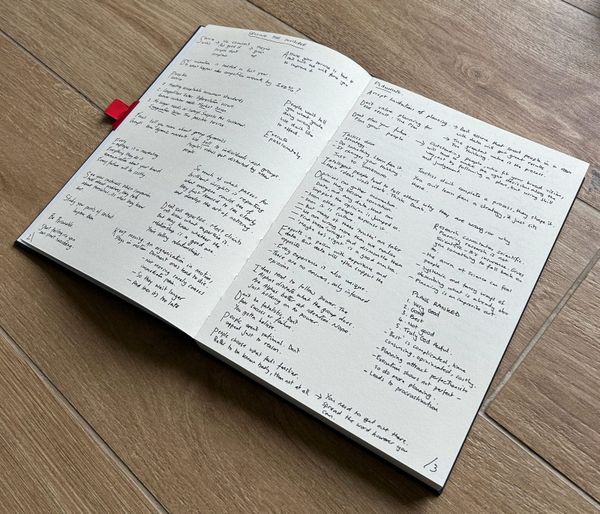
I use a lot of paper. Not out of nostalgia. Not out of rebellion against digital tools. I use paper because it changes how I think.


How different notebooks create different rooms for thinking
The wall in the stationery shop was covered in paper. Notebooks, planners, an old map, diaries. Paper. Lot's of paper. And I was in my element.
I use a lot of paper. Not out of nostalgia. Not out of rebellion against digital tools, because I use a fair few of those too. I use paper because it changes how I think. A blank notebook is possibility. A familiar pen is a ritual. A dedicated notebook is a container for a particular kind of activity. Sitting at my desk, pen in hand, paper on the desk – it's my happy place.
Stationery, for me, is not a hobby. It is an operating system for my life's work. Well, of course, there's this website, the videos, the podcasts...I'm a complicated person.
Over time, I’ve learned that different kinds of thinking benefit from different physical spaces. So I use multiple notebooks. Not for aesthetic pleasure, but for cognitive separation.
A legal pad for drafting and working ideas through. A small notebook for hopes, plans and long-range intentions. A journal for thoughts and emotions that need space to unfold. A ledger to record what actually happened – neutral, factual, unedited, exactly like a financial ledger but with activity. A sketchbook for visual thinking, diagrams, and doodles that words can’t quite capture.
Each notebook becomes a room and space. When I open it, I enter a particular mode of thinking.
I write most important things by hand. Talk outlines. Book drafts. Video scripts. A painted picture for life. My goals. Not because it is efficient, but because it is effective. Handwriting slows thought, mostly through the friction it creates. But on the other side of all friction is a reward. And that reward is clearer thinking and a better memory.
Paper forces ideas to pass through the body, through the hand, and on to paper. Not just opening Apple Notes and bashing away at the keyboard. What I write by hand tends to stay with me. Digital tools help me move fast but paper helps me move deliberately.
Recently, I began keeping a daily ledger. Not a journal, not a planner either, just a record of events from the day. The mundane (created a learning note from the Rick Rubin podcast), sit with the more remarkable (a five metre branch fell from the tree, nearly squashed the cat). What happened that day and what stood out, and what mattered enough to capture it in the ledger. It feels like building a quaint archive of a life. Facts, not feelings. Records, not ambitions. Over time, patterns begin to appear.
Digital tools are designed for speed, scale, and stimulation. Paper is designed for attention. Ink resists deletion, although that TipEx nearby sometimes gets used. Pages resist distraction. Notebooks create a sense of permanence in a world designed for flux, archiving, quick search and sharing. This isn’t nostalgia. Not all of it anyway. It’s intentional friction. With a reward on the other side.
Stationery also brings the sense of ritual, the lost art of taking real time to build strong habits and sense of time and place. A good pencil feels good to hold and alludes to the potential that's about the follow. A fountain pen that slows me down and brings me real joy in using it. A ruler that makes lines feel precise. A pencil sharpener that turns maintenance into a small ceremony worth doing.
These are not productivity hacks. They are rituals that shape how I show up to work too.
Well, why does any of this matter? You see, ideas don’t arrive fully formed. If they did we'd all be writing novels, building amazing products from day one and inventing the next big thing. They need space, time, structure, and material to become real.
For me, paper is that material and the rituals create the other conditions to explore what I've seen, what the idea might become. It's where ideas move from fleeting thought to something that can be shaped, tested, built and shared. This is how ideas begin their journey toward value.
And I for one will keep buying notebooks. And yes, I seem to have a problem of another kind. 140 notebooks, unused, fill my writing desk drawers. I maybe only need to buy a notebook when I need it, not because it looks good and has glimmers of potential on the cover.
There's a video that goes with this piece, on Creative Soul Projects. Same person, same observation — just followed on camera instead of on the page.
Where this sits in the Atlas
Orientation·Idea to Value·Communication·Creativity & Climate·Learning