Jump into the void
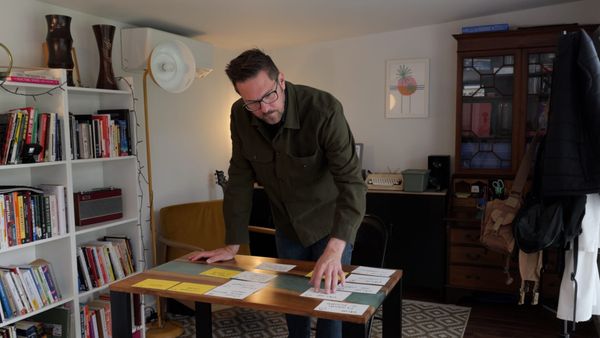
After a keynote last week, someone approached me with feedback that was, shall we say, unvarnished. This happens. There is always someone compelled to offer what I now think of as inflicted help.


Why making your work public changes the conversation
“He who jumps into the void owes no explanation to those who stand and watch.” — Jean-Luc Godard
After a keynote last week, someone approached me with feedback that was, shall we say, unvarnished.
They thought the story was weak, the characters implausible, the delivery off.
This happens.
There is always someone compelled to offer what I now think of as inflicted help.
Most feedback is generous, thoughtful, and useful.
Occasionally, it is neither.
Editor's note — where this sits
The engineA short reflection from the Engine layer of the Idea to Value system — the conditions that determine whether ideas stay private or become something the world can respond to.
Earlier in my career, moments like this would linger.
I would replay the words, re-run the talk in my head, and carry the weight of a stranger’s tone for days.
But stepping into public work teaches you something subtle and important.
When you jump into the void, the conversation changes.
The act of making something visible
— standing on a stage, publishing a book, shipping a product, sharing a thought
— shifts you from observer to participant.
From commentary to contribution.
The person offering critique is often not wrong.
They are simply looking from a different place:
the safety of the edge, not the uncertainty of the leap.
Their lens is observational, not generative.
So now, instead of defending the jump, I thank them for noticing that I jumped at all.
Because if I had stayed still, there would be nothing to comment on.
The Work That Speaks
Every creative leap gathers opinions.
When my team moved from fourteen-month releases to weekly ones, people said it was reckless.
When I started YouTube, people said the videos were poor. Some of them were.
When I wrote, shared, launched, published — responses ranged from enthusiastic to confused to dismissive.
That is the exchange.
To share work is to invite response.
You do not owe an explanation to those who watch.
But you owe yourself the commitment to continue.
Public work invites misunderstanding.
It invites projection.
It invites noise.
Private work invites nothing.
Silence has a cost.
Inaction has a cost.
Keeping ideas locked inside a notebook has a cost that compounds quietly over time.
On Leaping
When you step forward with an idea, you are not auditioning for approval.
You are testing reality.
You are learning.
You are contributing.
The void is not empty.
It is where ideas become value.
Keep building. Let the work do the explaining.