The Basics of a Good Induction Process
A good induction reassures new hires and helps them contribute quickly. Here’s a practical approach to onboarding that builds clarity, confidence, and momentum.


The basics of a good induction process
I once joined a company on a Monday morning and was home by lunchtime.
Not because the role was wrong. Because nobody had prepared for me to arrive. The car park barrier wouldn't rise. I waited an hour in reception for a manager who never came. Someone from HR showed me to a desk, didn't introduce me to anyone, and left. There was no computer. Nothing to do. I was sent home early because nobody quite knew what to do with me.
I quit after eight days.
That is the cost of a poor induction — not just the discomfort to the new starter, but the expense to the organisation. Recruitment costs, salary from day one, lost momentum, and eventually the whole process beginning again.
Induction is not hospitality. It is the work of converting a hiring decision into a productive experience, for the company and the employee. And most organisations do it badly.
Editor's note — where this sits
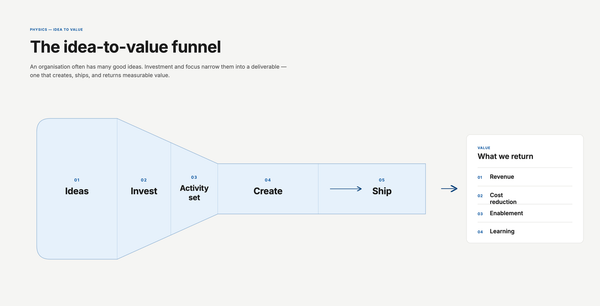
This essay sits in the Physics layer of the Idea to Value system — the diagnostic system for understanding what sits between an idea and the value it creates. A hire is an investment. From the moment someone accepts an offer, cost accumulates. Induction is the mechanism that closes the gap between that investment and the moment a person begins creating value in return.
The Idea to Value system — five layers
Three experiences, one choice
When designing an induction process, organisations tend to land in one of three places.
The first is the minimum — covering legal requirements, issuing a contract, handing over a laptop if they remember. The new starter does the work of figuring out where everything is, who everyone is, and what actually matters. They often wonder whether they made the right decision.
The second is the performance — a welcome pack, some branded merchandise, a group photo on LinkedIn. It looks impressive from the outside. Look closer and the process often ends after day one, leaving the new starter to sink or swim in the weeks that follow.
The third is what actually works. An induction designed from the new starter's perspective — removing stress, creating clarity, building relationships, and enabling contribution as quickly as possible. Not theatrical. Not bureaucratic. Just deliberate.
Most organisations settle for one or two. The gap between settling and designing is mostly intention.
What good induction is actually trying to do
A strong induction has two outcomes: it reassures people they made the right decision in joining, and it helps them become productive as quickly as possible.
Everything else is in service of those two things.
Which means induction is not gift bags, rituals, or forced icebreakers. It is the quiet, deliberate work of helping someone understand where they are, what matters here, and how to contribute. Confusion is an unnecessary tax on attention — and attention is the scarcest resource a new starter has in their first weeks.
In the Idea to Value system, everything between an idea and the value it creates is cost. A hire is an investment — time, money, and the energy of everyone involved in the process. From the moment someone accepts an offer, the organisation is incurring cost. Induction is the mechanism that closes the gap between that investment and the moment the person begins creating value in return.
A poor induction extends that gap. A great one shortens it considerably.
Before day one
The induction begins before anyone walks through the door.
Once a verbal offer is accepted, move quickly. Good people have options, and the period between offer and start date is when doubt creeps in. A personalised welcome message from the hiring manager — not a generic HR email, a genuine note explaining what they'll be working on, who they'll meet, what day one looks like — closes that gap before it opens.
A posted welcome pack in the week before they arrive serves the same purpose. Nothing elaborate. A notebook, a book worth reading, a letter that says they're expected and valued. The surprise of something arriving in the post is itself a signal: this organisation pays attention.
Make sure equipment is ready. Laptops, logins, access rights. Obvious, yet persistently neglected. Nothing erodes momentum like a capable person waiting for passwords.
Day one: orientation, not output
The first day sets the tone for everything that follows.
The hiring manager should be present and ready to greet the new starter — not HR, not a colleague, the person they will work most closely with. That presence matters. It signals that this hire was wanted, not just processed.
A tour of the space, introductions to the heads of each team, clarity on the practical details — where things are, how things work, what the unspoken norms are. Then time with the team, and crucially, time with their buddy.
The buddy is not a formality. Pair a new starter with someone already capable in the role — someone who is a genuine ambassador for the culture, not just available. Their job is to answer the questions that don't make it into any handbook: the shortcuts, the politics, the things everyone knows but nobody wrote down. Proximity creates capability. A good buddy in the first month is worth more than any amount of onboarding documentation.
What the first day should not be: an expectation of productivity. New starters need time to acclimatise. The first day is for orientation, relationship, and the beginning of belonging. Belonging is a prerequisite for contribution, not a reward for it.
Day two: becoming company smart
If day one is about orientation, day two is about understanding.
I call this becoming company smart — grasping the painted picture the organisation is moving toward, what the company values, what the product or service does and why customers pay for it, and how commercial reality shapes the work.
This is best delivered through a mix of self-directed reading and face-to-face conversation — ideally with a leader or executive who can bring the strategy to life and field questions directly. That combination of individual pace and live dialogue is more effective than any presentation delivered to a passive room.
The goal is context. A new starter who understands why the company exists, what it is trying to achieve, and how their role connects to that picture will make better decisions, ask better questions, and adapt faster.
The first week and beyond
By the end of the first week, a new starter should understand the product or service at customer level, have a sense of how it is sold and to whom, have met the key people they will depend on and who will depend on them, and feel oriented enough to begin contributing in week two.
Weeks two and three are for doing the work — with increasing independence, decreasing hand-holding, and explicit conversations about what coaching and development will look like over the coming months.
The induction is not an event. It is a process that runs through the end of probation. Each stage provides information about what is working and what is not. Feedback from new starters — honestly gathered and genuinely acted on — is one of the most reliable ways to improve an organisation's ability to bring people in and get them productive.
The manager's responsibility
Much of what makes induction work or not sits with the hiring manager, not with HR.
HR can design the process. The manager has to show up for it. Being present on day one. Setting up regular one-to-ones early. Explaining how feedback, goals, and coaching will work before the new starter has to guess. Transparency builds trust faster than any onboarding pack.
A new starter who feels oriented, supported, and trusted will begin creating value sooner. And when that happens, the organisation benefits — not eventually, but immediately. The cost of the gap begins to close.
That is the purpose of induction. Not hospitality. Enablement.
From the Cultivated free library
Join Our Company — and other free guides
PDF download · Free
The full book this essay draws on — a practical guide to hiring, induction, and building the kind of organisation people want to stay in. Free to download, alongside other guides and resources from the Cultivated library.