The Idea to Value Handbook
A practitioner's handbook for moving ideas through a real organisation — 26 principles, with the red flags, steps and moves for when work gets stuck. Free for Studio members.
A practitioner's handbook for moving ideas through a real organisation — 26 field-tested principles, and what to do when the work gets stuck. Free for Studio members.
For the people who have to make it happen
Most writing about work is built to be nodded at. This is built to be used — in the meeting that keeps going in circles, on the initiative that's been "nearly done" for a month, on the wet Tuesday when the strategy is sound and the work still won't move. And you've run out of good coffee and biscuits.
Here's what that means in practice. The twenty-six principles come as working tools, not essays: each one gives you the red flags that a piece of work is stalling, the steps to take when it is, and the examples and moves that reliably help. They're short, and built to be opened at the exact problem in front of you — you reach for one when something's stuck, find the pattern, and act.
It's for people with a real situation to work through: consultants structuring their thinking with a client, managers who want their part of the business to work better, founders turning a good idea into something people will pay for. Whether your world is six people or sixteen thousand, the shape of the journey is the same — and so are the places it tends to stall.
The Idea to Value system
The same body of work, shaped for different needs — from the thinking behind it, to the calm read, to the guide you work from. Take whichever fits where you are right now.
The Philosophy
The thinking underneath it all
Why any of this matters, and the twenty-year practice it grew out of — a working life spent paying attention to how ideas become value. Start here for the worldview beneath the work.
The Life of an Idea
Pocket-sized digital field guide
The whole system in its calmest form — short chapters you read like essays, turning each idea over slowly. The place to start if you want to see how work becomes value, and think about your own differently.
The Idea to Value Handbook
26 applied principles · free with Studio membership
The working version of the same system — every principle with its red flags, practical steps, and the moves to make when a project is stuck. The handbook you reach for on the job.
From idea to sustainable work
A 50-page guide and 40-minute audio for independents who want to build something durable — not just visible.
The early grind isn't you getting it wrong. It's the cost every idea pays before it pays you back. The skill is staying in the game long enough to come out the other side. For solo creators, independents and people working on their own spend.
This has done real work
These aren't theories. They were shaped over more than twenty years inside real organisations — as a VP of Engineering and a VP of HR, growing a start-up from a handful of people to a couple of hundred, and then a decade of consulting with companies ranging from a few people to sixteen thousand. They've helped recover stalled programmes, take delivery times from months to weeks, and cut operating costs while lifting morale. They're also the foundation of a consulting practice that has comfortably supported a six-figure income, doing work I'm proud of.
I mention it not to impress you, but to reassure you: what's in here has been tested against real budgets, real deadlines and real people. It earned its place through results, not by sounding clever in a workshop.
What's inside
Twenty-six principles, each one short and built to be applied. Every principle follows the same shape, so you always know where you are: what it is, why it matters, what it looks like when it's working and when it isn't, the red flags to watch for, a real example, a few practical steps, reflection questions, and a one-line takeaway.
The principles are orientated around the life of an idea, as it changes shape and form to become something tangible, then something valuable.
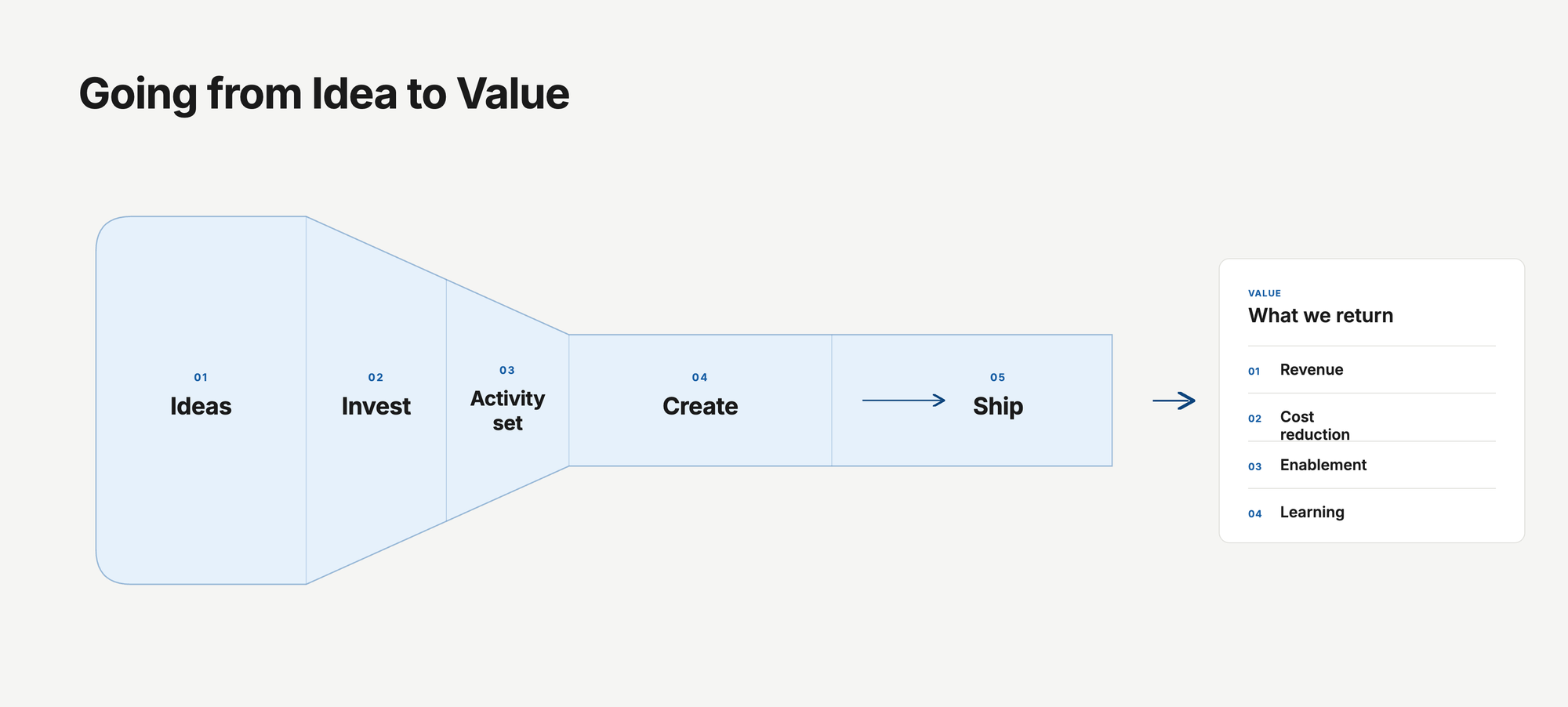
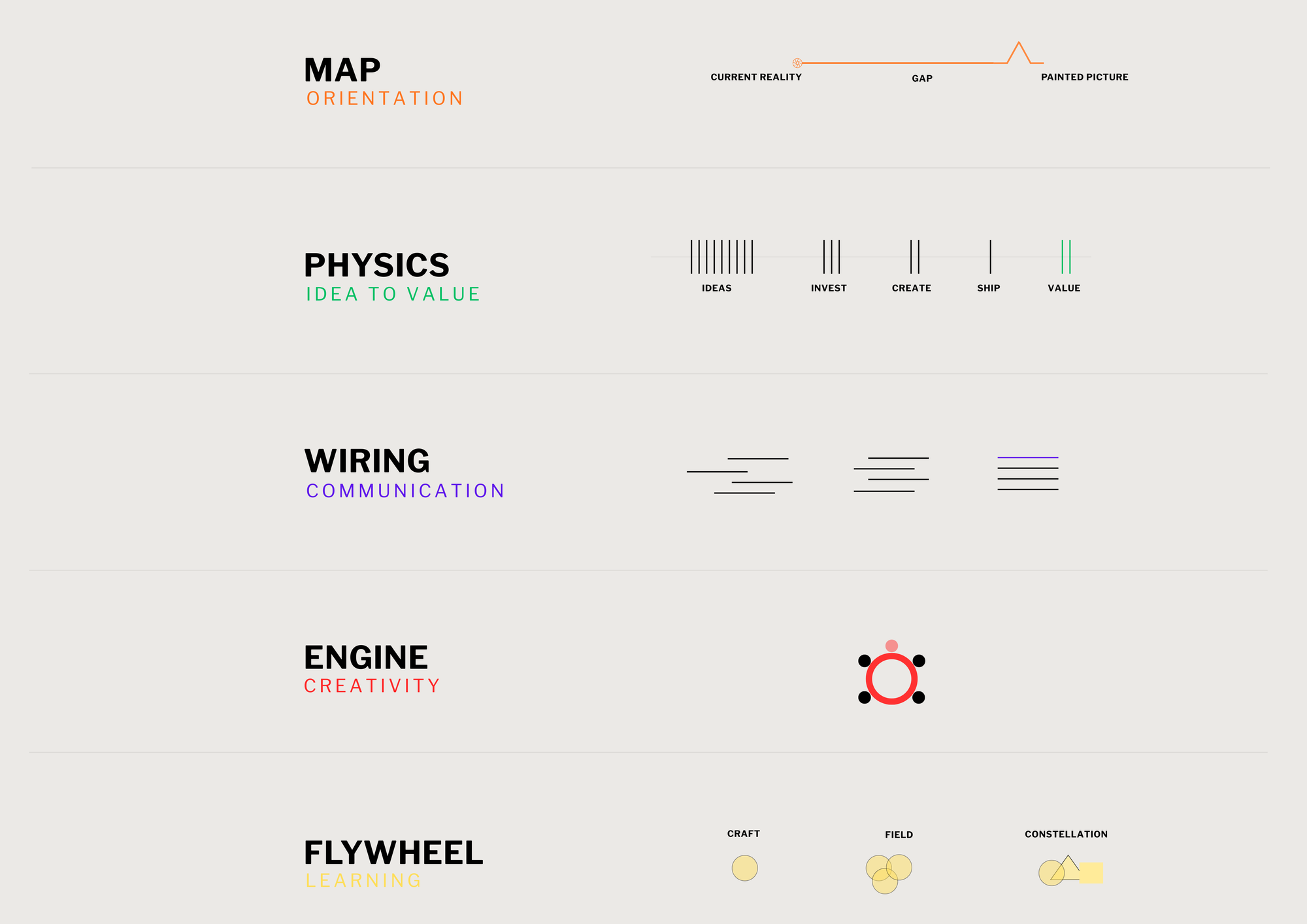
They are organised into the five layers of the Idea to Value system — the terrain an idea has to travel through:
- The Map — direction and orientation. Knowing which way value is before you start walking.
- The Physics — how ideas actually move, and where they lose energy on the way.
- The Wiring — communication and meaning: how understanding travels between people, or doesn't.
- The Engine — creativity and climate: the conditions that let good work happen.
- The Flywheel — habits and compounding: how good work becomes a practice rather than a lucky one-off.
Underneath all of it, one question you can hold against any piece of work: does what we're doing right now help this idea move to value?
A principle, in full
So you can see exactly what you'd be getting here's one of the twenty-six, complete.
Never overload the funnel · The Physics
The principle. A motorway carries the most traffic at around seventy per cent of capacity. Push past that and flow collapses into a jam — completely full, moving almost nobody. Teams are motorways. Run them at full capacity and they don't go faster; they seize. Work stacks up at the handovers, everything sits at eighty per cent done, and value — which only appears when something is finished — slows to a trickle.
Why it matters. Slack isn't waste; it's the room good work needs in order to move, learn, and absorb the surprises that work is mostly made of. A system with no margin can't absorb a surprise.
What it looks like in practice. When it's working, teams limit what's genuinely on the go, pull the next thing when they're ready, and keep deliberate margin. When it isn't, everyone is loaded to the brim because a gap looks like waste — plenty started, little finished, and no capacity to absorb anything unexpected.
Red flags.
- Everyone on three or four things at once.
- Work sliding back and forth between handovers.
- Lots in progress, and nothing quite finishing.
Example. A marketing agency ran ten to fifteen tasks per person per week, everyone flat out, almost nothing shipping on time. They cut it to three or four active tasks each — same people, same week — and began delivering more, faster, at better quality, with less stress. Because of doing less at once, not despite it.
How to apply it.
- Count what your team genuinely has on the go at once.
- Halve it, and watch what happens to how much finishes.
- Let teams pull the next thing when ready, and protect real, deliberate slack.
Reflection questions.
- How much is actually in progress at once on your team?
- What would finish if you halved it?
Summary takeaway. Slack isn't waste. Slack is the room the good work needs in order to move.
The full handbook is yours as a Studio member
That's one of twenty-six. The rest — the complete handbook, as a clean PDF you can keep on your phone, print, and mark up — comes free with membership of the Studio and can be accessed below.
Studio membership also brings you the Department of Interesting Things: a monthly deep-dive letter where we explore a single artefact and follows the idea wherever it leads, always giving you practical and tactical advice you can directly apply to your work. Studio members also get the frameworks, members-only essays and working notes behind everything here.
Join the Studio to read the full handbook →
Already a member? Sign in to read and download it.