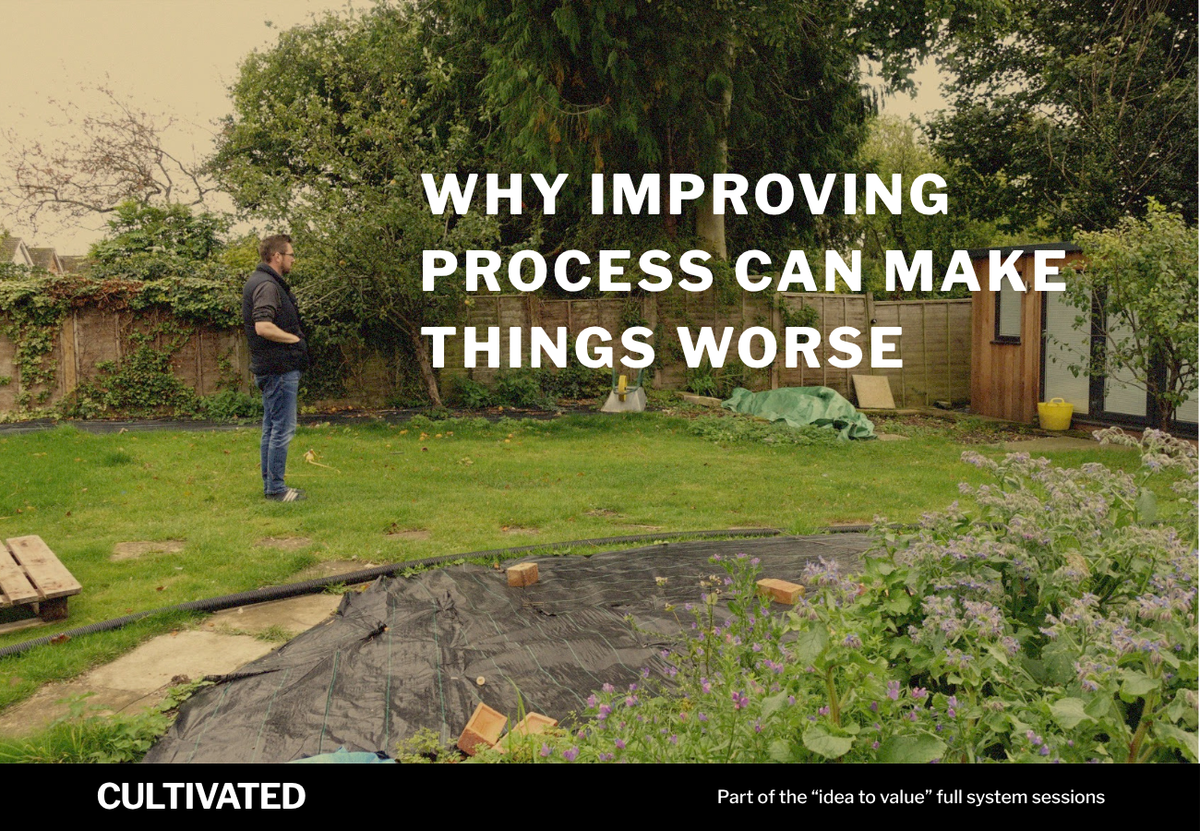
Why Improving Process Can Make Things Worse
Better processes don’t guarantee better outcomes. This piece explores why improving the wrong system can accelerate failure — and why direction must come first.
Editor’s Note
These sessions explore the Idea → Value system in practice — slower, deeper, and closer to real work. If the essays sketch the outline, these sessions walk the terrain.
Why Direction and People Must Come Before Efficiency
Process improvement is seductive.
There is comfort in diagrams.
Satisfaction in optimisation.
A quiet belief that if we could only refine the steps..
the outcomes would follow.
And sometimes, they do.
But a perfect process moving in the wrong direction…
is simply efficient misalignment.
Processes are meant to serve the journey from idea to value.
They are scaffolding.
Not the building.
If clarity is missing,
if alignment is absent,
if people are not equipped or supported…
then improving the process only deepens the problem.
It makes the failure faster.
More consistent.
More expensive.
This is why the order matters.
Effectiveness before efficiency.
Always.
A process without purpose becomes ritual.
A process without discipline becomes chaos.
A process without people becomes theory.
This is not a rejection of process.
It is a reminder of its place.
First: direction.
Second: people.
Third: process.
When those foundations exist…
process improvement becomes powerful.
Measured.
Meaningful.
Grounded in reality.
This is where you begin.
Study the flow.
Map it.
Follow a single idea from beginning to end.
See who touches it.
Where it pauses.
Where it loops.
Where it stalls.
Then ask the question that is often avoided:
Why does this process exist?
Some exist for regulation.
Some for safety.
Some for learning.
Some simply exist…
because no one has questioned them.
Measure cycle time.
Attach cost.
Visualise the invisible.
Not to punish.
To understand.
And once improved…
protect it with discipline.
Because a well-designed process, followed consistently…
is liberating.
It reduces cognitive load.
It frees attention.
For creativity.
For collaboration.
For judgement.
But a well-designed process, ignored…
creates disorder.
And we cannot forget the dual nature of work.
Some work is complicated.
It can be analysed.
Designed.
Optimised.
But much of it is complex.
It involves people.
And no diagram predicts emotion, egos, ambitions, goals, drive, miscommunication.
No flowchart guarantees behaviour.
The human element remains.
This sits inside the Idea to Value.
Because process is only one part of the journey.
Not the starting point.
Not the destination.
Just one part of how ideas move into value.
So improve the process, yes.
But only after you are certain…
you are improving the right journey,
with the right people,
toward the right future.
Because a smoother road is meaningless…
if it leads nowhere worth arriving at.
In the full session, we explore how to improve processes without losing direction,
how to balance efficiency with effectiveness,
and why process should always follow purpose.
Go Deeper
This article introduces one part of the Idea → Value system course.
If you want to go further — to see how this works in real organisations, and how to apply it in your own work — there are three ways to continue:
- Watch the full studio deeper session — a rich and detailed walkthrough of this idea in practice (available in the Studio) - below.
- Buy the Idea to Value course complete with field guide - and companion video series.
- Start with the Orientation Session — a 20-minute overview of how ideas move from concept to value
All are designed to help you not just understand the system…
but use it.