Why Stable Teams Outperform Constantly Changing Ones
Constantly reshuffling teams slows everything down. This piece explores why stable teams build momentum, trust, and knowledge — and how flowing work to teams improves performance.
Editor’s Note
These sessions explore the Idea → Value system in practice — slower, deeper, and closer to real work. If the essays sketch the outline, these sessions walk the terrain.
How Continuity Builds Trust, Knowledge, and Momentum
There is a difference between a group of people and a team.
A group assembles.
A team accumulates.
In many organisations, work arrives like the weather. And you know I like talking about the weather.
A new initiative appears.
Funding is approved.
People are gathered together around it —
available hands, shifting calendars, fragments of attention.
They form.
They introduce themselves.
They work out who knows what.
And just as momentum begins to build…
the weather changes.
The team dissolves.
The knowledge evaporates.
The relationships reset.
And the cycle begins again.
It is an expensive rhythm.
Not always in money alone —
but in time, energy, and the invisible cost of starting over.
Stable teams do something different.
They compound.
They learn each other’s rhythms.
They build trust without needing to announce it.
They develop a shared language — a shorthand of glances and half-sentences.
They begin to understand not just the work…
but the world around the work.
The customers.
The patterns.
The future implications.
So when a stable team receives new work…
it does not begin at zero.
It begins in motion.
This is the difference:
Building teams around work…
or flowing work to teams.
The first is reactive.
The second is accumulative.
And this sits directly inside the Idea to Value.
Because every time a new team forms…
the system pays a hidden tax.
Time to collaborate.
Time to build trust.
Time to understand the domain.
Three months is not uncommon.
Three months of cost…
before meaningful momentum appears.
And just as performance begins to surface…
the team disperses again.
Taking its knowledge with it.
Like footprints erased by the tide.
Stable teams change this equation.
They hold knowledge.
They hold relationships.
They hold care.
And care is the subtle force here.
People improve what they expect to encounter again.
They invest attention differently…
when the work is not temporary,
when the customer is not anonymous,
when the product is not simply passed along.
There is something deeply human in this.
Relationships are not overhead.
They are the connective tissue of effective work.
When people know they are not just passing through…
they invest more of themselves.
The work becomes something shared.
Not just a task…
but an endeavour.
A mission.
This does not remove variety.
Work can still change.
Challenges can still evolve.
But the container remains stable…
while the work flows through it.
And in that stability…
performance compounds.
Throughput improves, yes.
But so does something more important.
Continuity.
Morale.
Understanding.
Confidence.
Relationships.
The kind that comes from knowing each other well enough…
to move without hesitation.
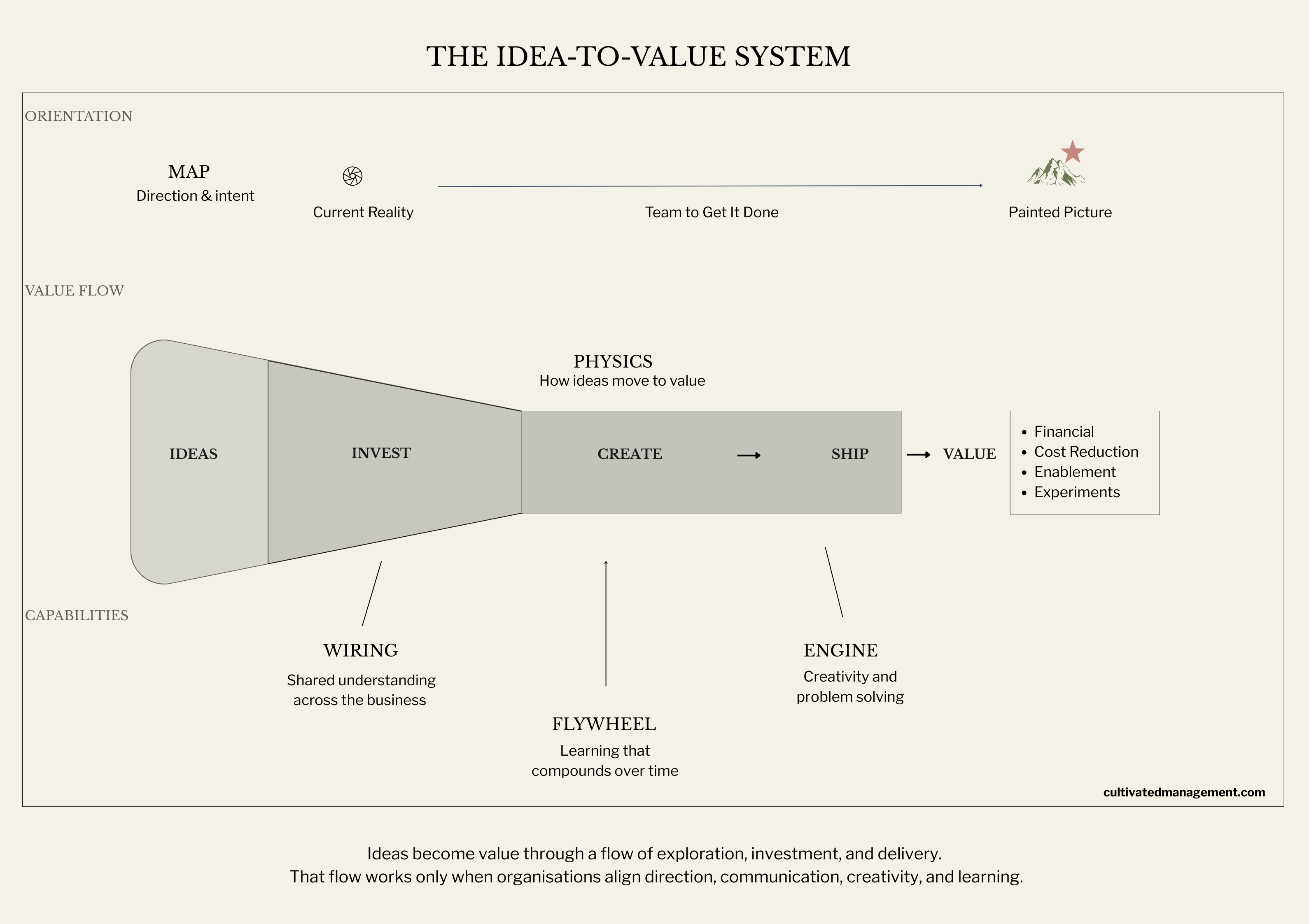
The funnel smooths.
Friction reduces.
Ideas don’t stall in the middle…
waiting for strangers to learn each other’s names.
They move.
In the full session, we explore how to structure work around stable teams,
how to reduce the hidden cost of constant reformation,
and why continuity is one of the most overlooked drivers of performance.
Go Deeper
This article introduces one part of the Idea → Value system course.
If you want to go further — to see how this works in real organisations, and how to apply it in your own work — there are three ways to continue:
- Watch the full studio deeper session — a rich and detailed walkthrough of this idea in practice (available in the Studio) - below.
- Buy the Idea to Value course complete with field guide - and companion video series.
- Start with the Orientation Session — a 20-minute overview of how ideas move from concept to value
All are designed to help you not just understand the system…
but use it.