Amplify, don't just fix
Months into a startup doubling year on year, the team was tiring in the messy middle. So I bought posh biscuits and ran a very different kind of workshop. On Appreciative Inquiry, and the discipline of studying success.


Inquire. Appreciate.
We'd been slogging away for months. The kind of hard daily effort that, in the moment, never quite feels like it's leading anywhere. We knew it was. But we also knew people were beginning to tire. Tire of the endless platform problems, of the constant arrival of new teams as the company doubled year on year, of the long hours poured into a painted picture we all genuinely believed in.
And that's the thing nobody warns you about: even when you're building something that matters, and journeying toward a future you can see clearly, the messy middle gets to you. It's the same whether you're writing a book, launching a business, or building a multi-million-pound startup – somewhere in the middle it stops feeling like a climb and starts feeling like a cliff you're about to walk off.
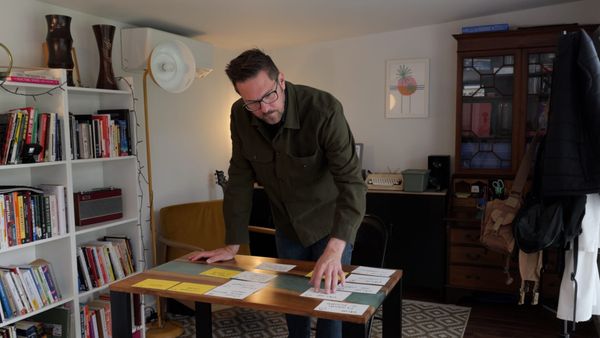
So, I carved out some space in the calendar, bought some nice pop and some good tea and a tin of posh biscuits, and pulled the team together for a very different kind of meeting. An Appreciative Inquiry.
I'll cut to the chase. It isn't really a meeting – not as I define one, anyway – it's a workshop. And not only did everyone enjoy it, not only did they leave more energised than they'd arrived, not only was it a genuine breath of air in a hard summer – it produced some staggeringly good next moves. Moves we'd never have spotted in the usual course of the work.
Because that's the pleasant trick of it. Most meetings and most workshops exist to solve problems: something's broken, something's stuck, someone needs help, someone needs to decide – or, worst of all, someone needs "updating," which isn't really a meeting at all. An Appreciative Inquiry throws all of that out and points everyone at one question instead: what's actually going well?
And what we found, on a hot afternoon in Basingstoke, was that beneath the graft and the firefighting and the general turmoil of a company growing rather faster than was comfortable, a surprising amount was going quietly, pleasantly, perfectly right.
One thing I've learned: there is real discipline in choosing to look at what's working. It's the harder thing, not the softer one, not the easier one. Because in most organisations, attention is dragged relentlessly toward what's wrong. Meetings open with what's broken. Reports flag what went wrong. Dashboards glow an anxious red, or a false green. And over enough time that creates a subtle, but obvious, distortion in everyone: people start to believe that progress only ever comes from fixing faults.
Appreciative Inquiry takes a different mightier stance – and it's neither naive optimism nor a way of dodging the hard stuff. It's the deliberate practice of studying success: of working out where value is being created, and asking, with deep curiosity, how you might make more of it. It's one of the most useful formats I know for strategy, direction and change – and one of the most useful things you can do with good people, who want to do more good stuff.
It's pleasing to see how something shifts the moment people are invited into that kind of frame. The good sessions start with charmingly simple questions – what's working well right now, where are we winning, what should we protect and reinforce and extend and do more of? You can see and feel the energy in the room change as they're asked. Defensiveness drains away. People speak more freely. People smile and fun, pride and gratitude prevail.
People start, often for the first time, to recognise their own role in the things going right and well. And it isn't an accident: ask a person to catalogue problems and they retreat into caution; ask them to notice success and they lean forward, grab a biscuit and let you know, with abundance. Appreciation makes a room safe without any need for ice breakers and ceremonies from a dubious playbook on Psychological Safety. It firmly gives people permission to be honest about what helps the work move.
None of which pretends the problems aren't there, far from it. Problems need attention – just not all the attention, all of the time, in every gathering of people. And when you carve out a space where the only job is to study what works, something genuinely useful happens: the team starts to see not just that it succeeds, but how. The patterns surface. The deconstruction of methods happens. The behaviours that made it so become crystal clear. The collaboration, cooperation, hard work, elements of luck and attention to high standards come forth with remarkable clarity. And once people understand why a thing works, they can do it again on purpose – which means improvement stops being an exhausting act of reinvention and becomes the far cheaper act of reinforcement.
There's a human dividend, too, and I believe it's a big one. So much of good work – the effort, the craft, the care – is invisible on a dashboard; it never shows up in the metrics, so it never gets named. Appreciative Inquiry names it. It lets people feel seen not only for what they fix, but for what they do, week after week to turn ideas into something valuable. And from these insights – from feeling that the good work was noticed – ambition tends to grow on its own. Energy emerges. Hope and spirit come back. Done well, this is not a soft fluffy exercise at all. It's a sharply focused one on human potential and commitment.
If you want to run one, the shape of one is far from complex, and most of the craft is in the setup. Invite only the people who genuinely need to be there – every extra voice adds complexity, and complexity is the enemy of the easy, generative, positive quality these sessions run on. Say clearly in the invitation what it's for: this is about what's working, and problem-cataloguing belongs in a different time and space. Give it a rather decent amount of time too – two hours as a minimum, three if you can – and prepare a physical (or digital) space: a decent sized wall or whiteboard, sticky notes, good pens, room to stand and move rather than slump around a table. Food and drink genuinely help.
Then you move through four specific movements.
Discovery is where you surface what's already working: everyone writes their observations, brings them to the wall one at a time, reads them aloud, and you group the themes as they land – every person contributing, quiet or loud, junior or senior, no exceptions. Dream is where you amplify it: if we won an external award for the best team in the industry, what would the work look like; if we had no constraints at all, where could this go? Anything aired as a gripe or a problem goes politely into a parking lot for another day. Dreaming tends to generate ideas, big and small; you narrow them to the best two or three against three important filters – does it help the customer, does it help the business, is it good for the people doing it.
Design is where you pressure-test the surviving few: what would it actually take, what would you have to stop doing to make room, how would you know it had worked? And Plan is where you make it real and small – name who owns what, set the first milestone a week out at most, pick one substantial thing and a quick win or two, and resist the urge to start more than you can realistically get done.
Then two things that are easy to skip and shouldn't be. Close the session properly – repeat back what was decided, who has what, when you'll next meet – because the close matters every bit as much as the opening. And follow up, relentlessly, because the energy an Appreciative Inquiry generates is real, and it fades just as quickly. Without visible momentum and regular check-ins afterward, all you've run is an expensive pep talk.
And a word of honesty. This is not a substitute for solving problems. Some situations need cold diagnosis and an unflinching look at what's broken, and a working life built entirely of Appreciative Inquiries would be a delusional way to run a business. But when the default has become problem-first – when every meeting opens with what's wrong and every conversation treats getting better as repairing a deficit somewhere – something remarkably valuable is being lost. The best teams I know can switch lenses at will: they know when to fix and when to amplify, when to diagnose and when to deepen, when to correct and when, just occasionally, to stop and notice what's going right.
Because focusing on what works doesn't make a team complacent. It makes it confident – and confidence, the real kind grounded in evidence rather than wishful thinking, is one of the most underrated forces in good work.
We walked out of that hot room in Basingstoke tired, still, and still squarely in the messy middle of our journey. But we walked out knowing, with the evidence in hand, exactly what was worth protecting, what was worth amplifying and what moves to make next. And that, it turned out, was exactly what the team, the business, and our customers needed.
Where this sits in the Atlas
Orientation·Idea to Value·Communication·Creativity & Climate·Learning